

The 6-3 Vote That Puts Your Dividends on Notice
And two payers whose profits were set before the hike
This article is for general information only and is not personal financial advice.
Five weeks ago I showed you two dividend stocks built for higher rates, and I quoted the Reserve Bank’s promise to keep ‘increasing the cash rate target further if needed.’
On Tuesday 3 November it did. The cash rate went to 4.85%, the fifth hike this year and the highest since 2008, and then the bank dropped the promise.
Three of the nine board members voted to hold. The statement no longer carries September’s line about raising rates further, and the bank now expects inflation to hit 4.5% in the December quarter, up from its last forecast of 3.6%.
If you’ve been waiting for rate cuts to rescue your income portfolio, a split board with inflation still climbing is your warning shot.
Don’t Get Caught In The Dividend Trap
In August 2017, Telstra (ASX:TLS) told shareholders it would cut its dividend from 31 cents to 22 cents. For years it had been the classic Australian income stock. The shares fell about 10% that day.
There are two ways a dividend yield gets bigger. The company pays you more, or the share price falls.
Rate hikes will test your holdings.
A business that borrows to pay its dividend, or whose customers stop buying when their mortgage goes up, can get into trouble fast. The yield looks fatter as the share price falls, right up until the board cuts it.
In September we showed you the market had priced the 29 September hike before it landed. In October we said the place to hide was businesses that can lift their own income. A fifth hike makes that case stronger.
So where do you hide this time?
Today, two more for the watchlist. A property developer that has already sold 90% of this year’s revenue, and a salary-packaging business whose profit moves less than 1% with the cash rate.
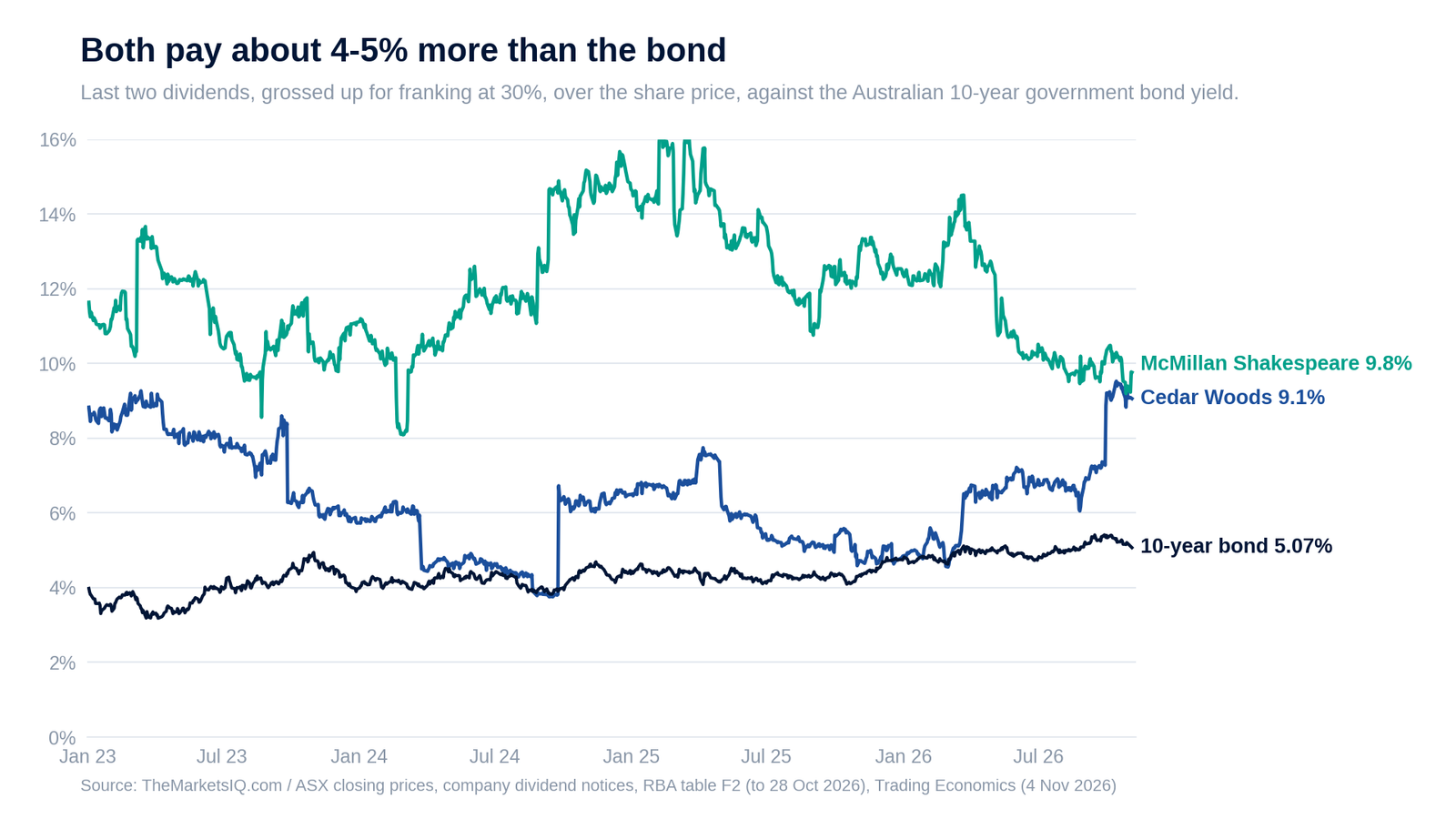
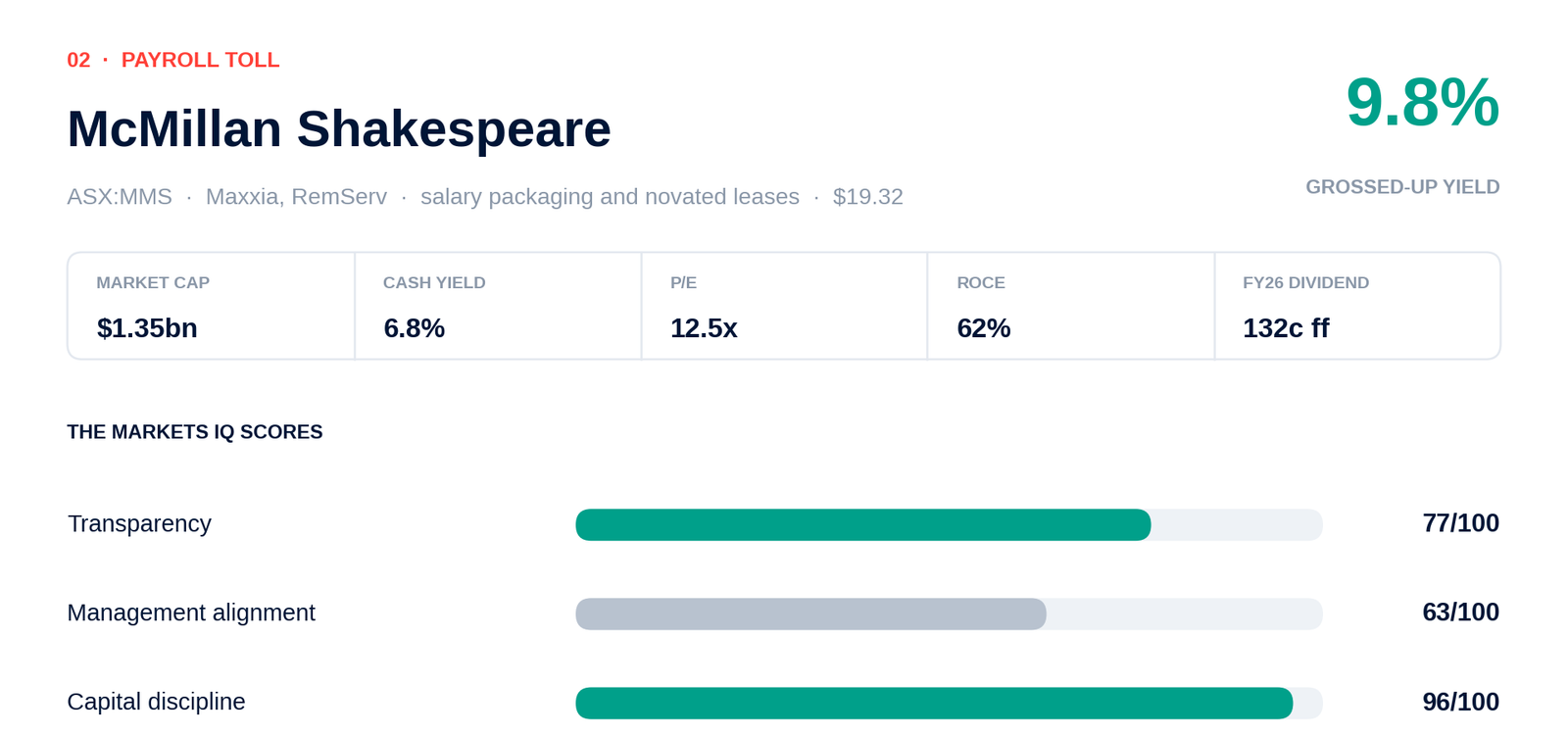
Both pay fully franked dividends. Grossed up for franking, Cedar Woods yields 9.1% and McMillan Shakespeare 9.8%, about 4-5% more than the 10-year government bond.
| Stock | Market cap | Latest result | NPAT (growth) | Dividend (fully franked) | Grossed-up yield | Next catalyst |
|---|---|---|---|---|---|---|
| Cedar Woods (ASX:CWP) | $523m | FY26 | $65.6m (+36%) | 39.0c FY, up 34% | 9.1% | Half-year result, late Feb 2027 (expected) |
| McMillan Shakespeare (ASX:MMS) | $1.35bn | FY26 | $106.7m (+11.4%) | 132c FY, down 10.8% | 9.8% | Half-year result, late Feb 2027 (expected) |
(Source: TheMarketsIQ.com / ASX announcements and company filings)
Both are for the year to 30 June 2026. Yields use dividends actually paid in the last 12 months. Prices and yields are at the close on 4 November 2026, grossed up at the 30% company tax rate.
The first company may have built a street near you.
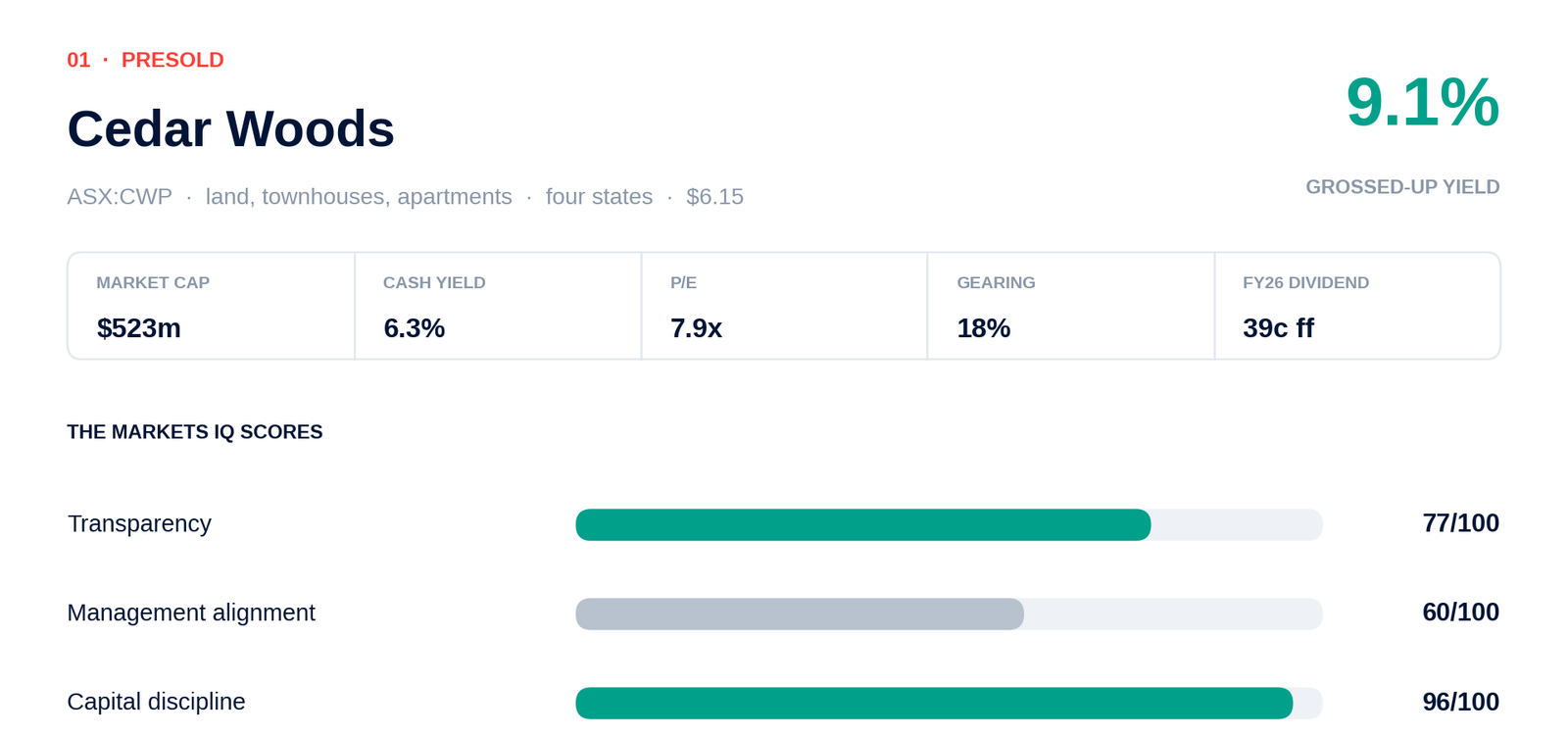
Cedar Woods (ASX:CWP), The Builder That Sold This Year Before It Started
Cedar Woods (ASX:CWP) turns paddocks into suburbs.
It buys land, gets it approved, puts in the roads and the pipes, and sells the lots, townhouses and apartments that go on top. It runs 36 projects across Western Australia, Victoria, Queensland and South Australia.
A developer’s profit comes in late.
A buyer signs a contract and pays a deposit today, and the company books the sale when the title settles, often a year or two later. That gap is the whole point of this story. Cedar Woods has already written most of its FY27 profit, and those buyers have signed.
Profit Up 36%, Dividend Up 34%
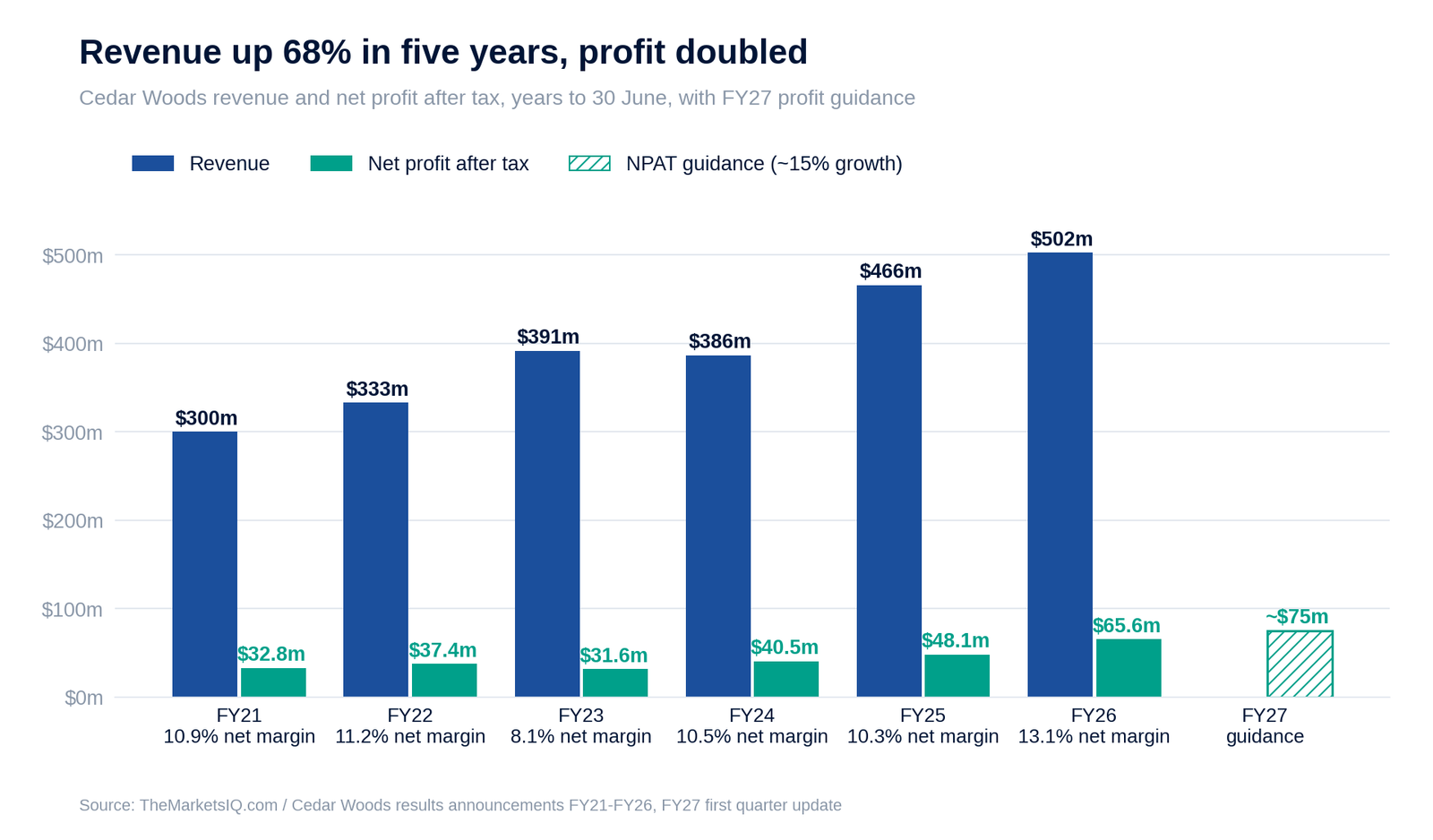
In FY26, revenue rose 8% to a record $502.4m. Gross margin climbed to about 30%, from 28%. Net profit rose 36% to $65.6m, and earnings per share rose 33% to 77.9 cents.
The fully franked dividend rose 34% to 39.0 cents.
Managing director Nathan Blackburne laid out the year ahead.
‘We enter FY27 with $830 million in presales and more than 90% of forecast revenue for FY27 already contracted. This materially reduces near-term sales risk and supports our target of delivering a further 15% increase in NPAT.’
Nathan Blackburne, Managing Director, FY26 results, 25 August 2026
$763 Million Already Signed
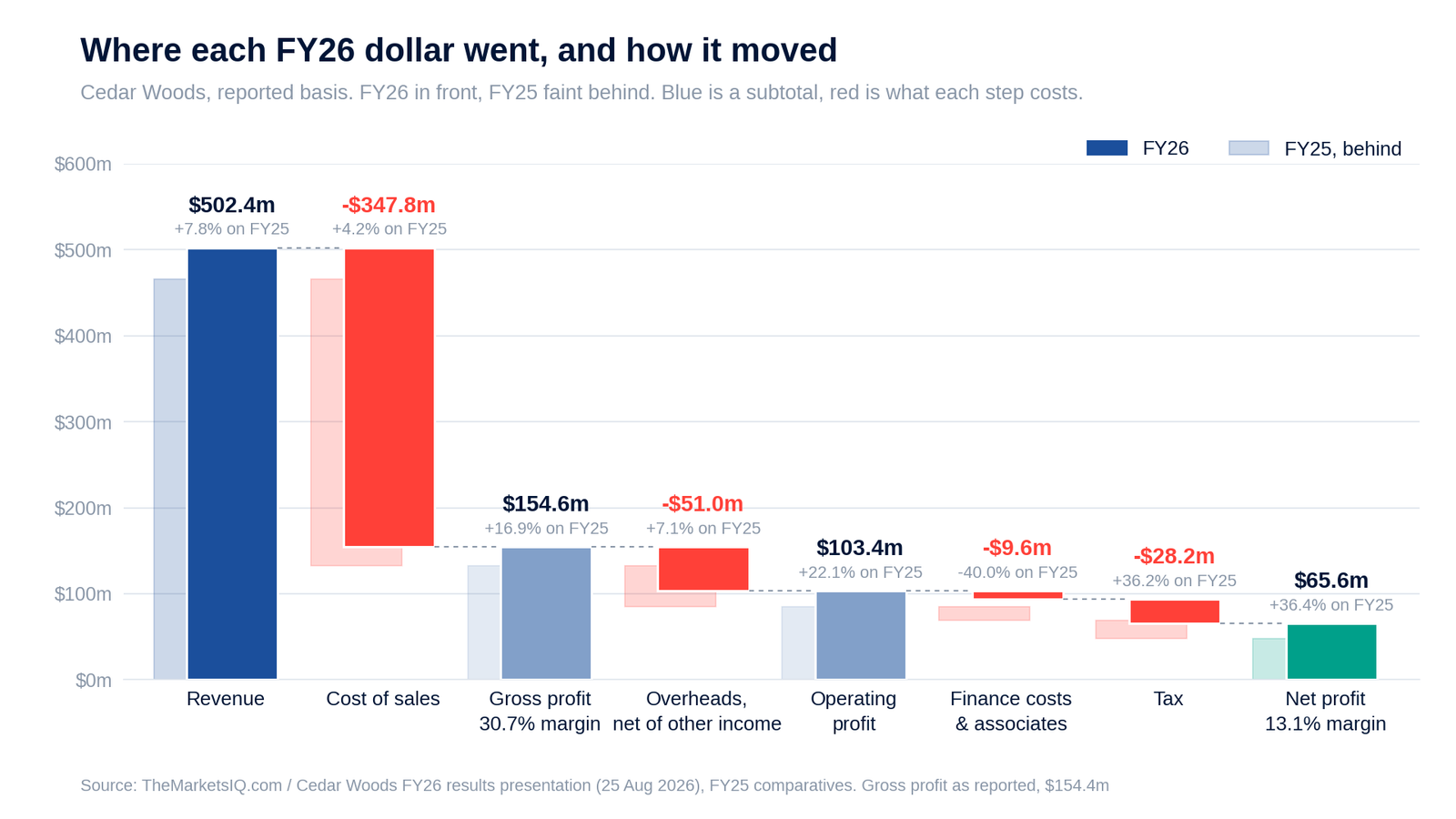
At the first-quarter update on 27 October, the company said it was ‘on track to deliver NPAT guidance of approximately $75 million’. It completed 311 settlements in the quarter, ahead of budget, against a full-year target of 1,100 to 1,200.
Presales sat at $763m at 30 September, the same as a year earlier. About $380m of those settle in FY27, $316m in FY28 and $67m in FY29.
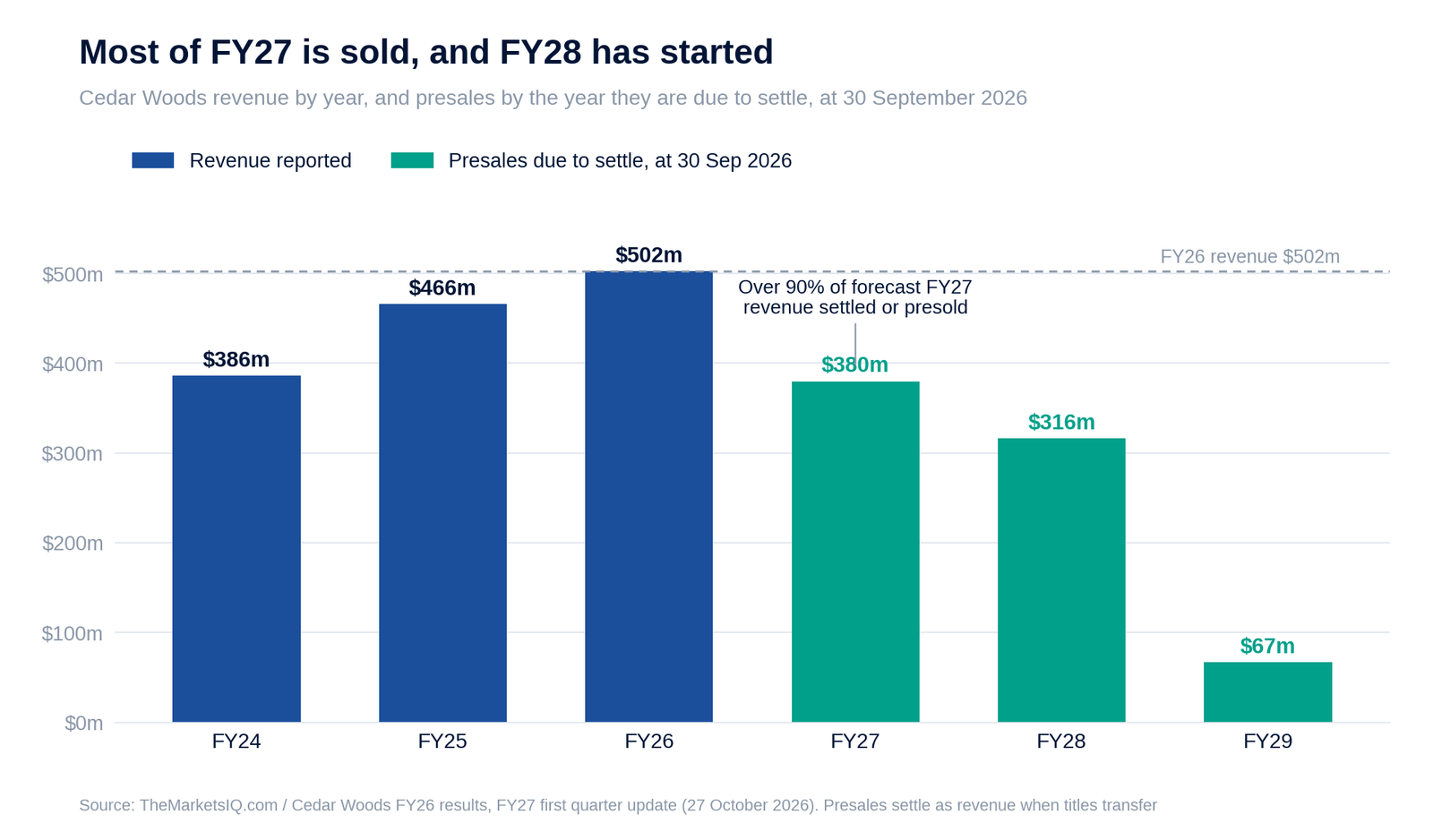
FY28 is still 20 months away, and it already has $316m signed, close to two-thirds of FY26’s revenue.
The balance sheet is light for a developer. Gearing was 18% at 30 June, and the company had more than $120m of available liquidity.
At $6.15, the 39-cent dividend is a 6.3% cash yield, or 9.1% grossed up. The shares trade on 7.9 times FY26 earnings. Divide the $75m guidance by today’s 85.1 million shares and you get about 88 cents a share, or 7.0 times. That’s simple arithmetic on the company’s own guidance.
The dividend takes half of earnings, so there’s plenty of room for the board to hold it if sales stay soft.
Then The Market Marked It Down 32%
The shares hit $9.10 on 2 March. They closed at $6.15 on 4 November, down 32%. Over the same stretch the Small Ordinaries (XSO) fell about 22% from its January high.
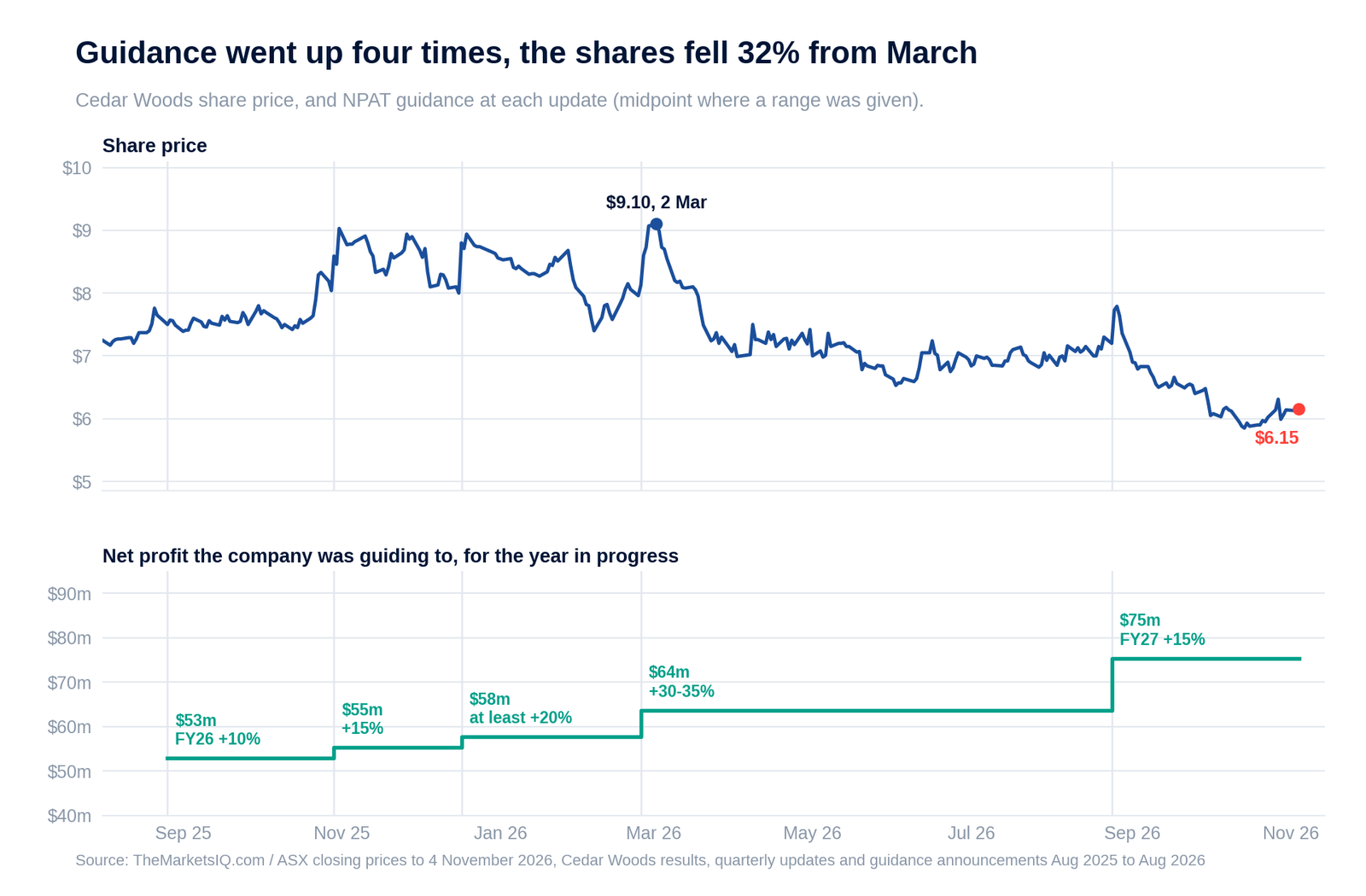
So the price fell while guidance went up. That gap is what puts it on a watchlist.
One large investor has been buying. Wilson Asset Management lifted its stake from 6.66% to 7.78% in August.
240,000 Homes a Year, 208,000 Approved
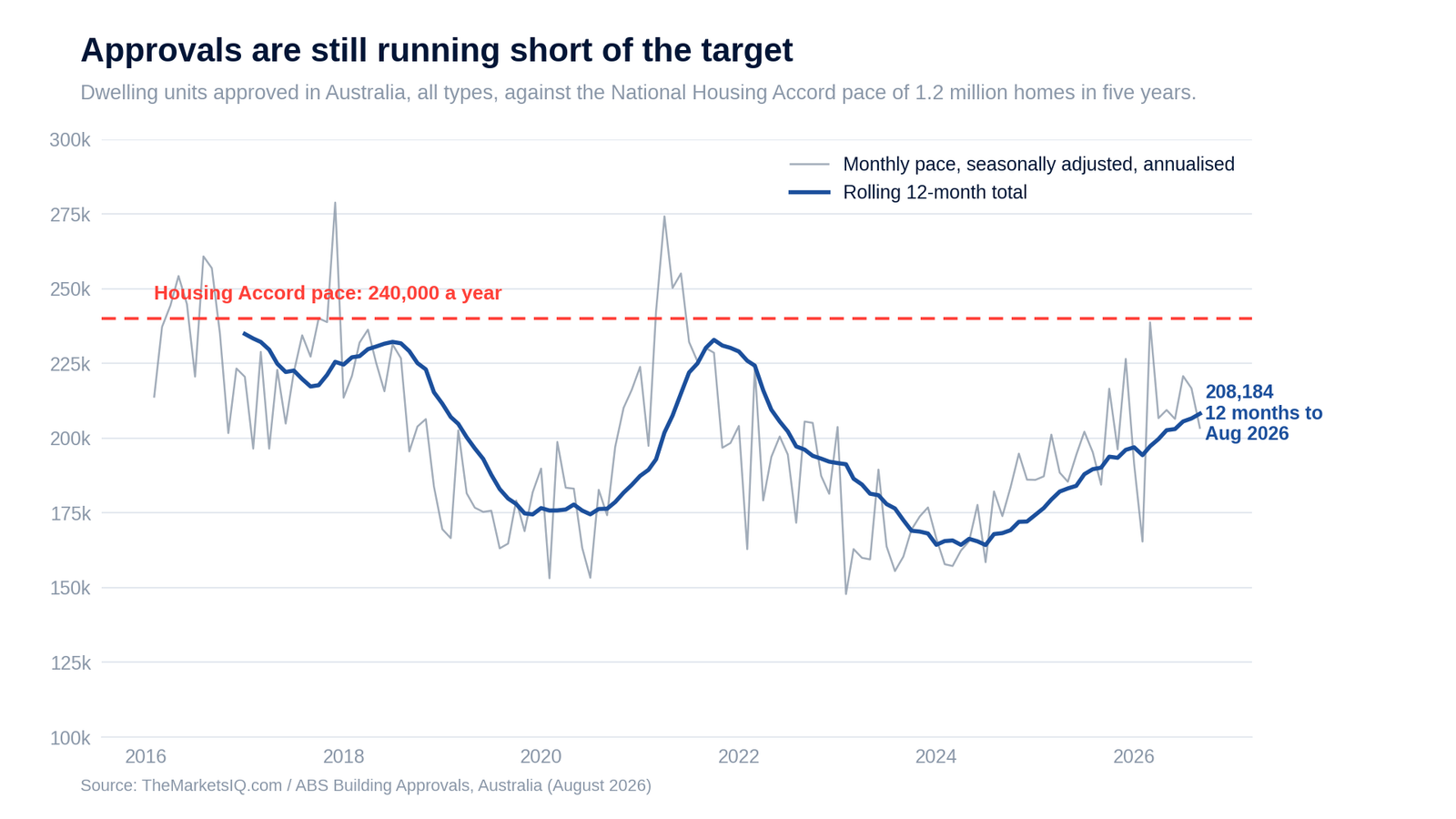
Canberra’s National Housing Accord aims for 1.2 million new homes in the five years from July 2024, or about 240,000 a year.
The Australian Bureau of Statistics counted about 208,000 dwelling approvals in the 12 months to August 2026.
Cedar Woods has 9,651 lots, homes and offices left to sell across its 36 projects. At this year’s settlement target, that’s eight or nine years of supply.
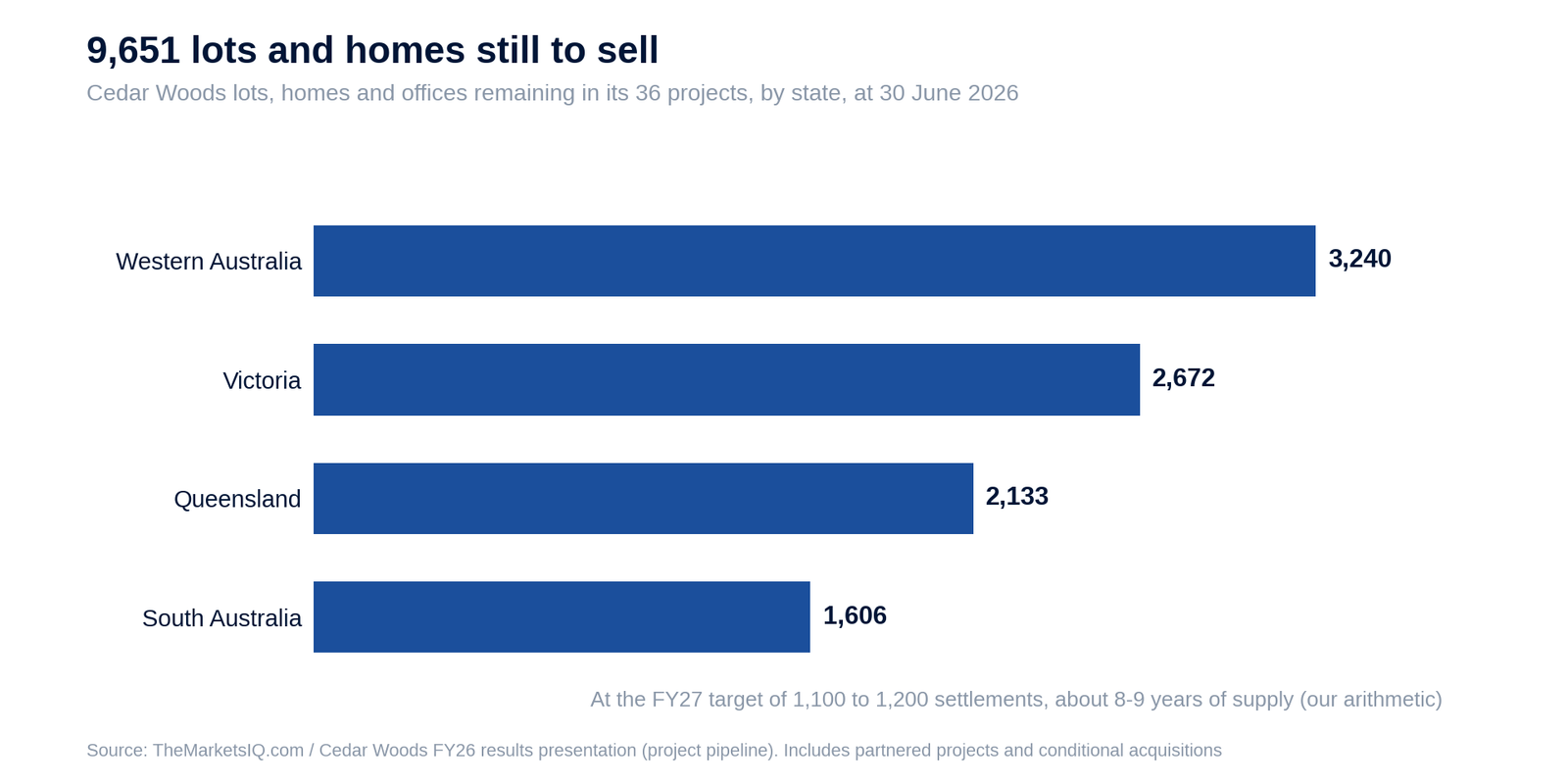
That shortfall is the reason the company calls the outlook ‘structural’.
‘The structural undersupply of housing continues to support the medium-term outlook.’
Cedar Woods, FY27 first quarter update, 27 October 2026
The Risk Management Is Flagging
Rate hikes hit Cedar Woods through its buyers. New sales slowed hard in the first quarter.
‘The Company recorded 167 gross sales in the quarter, down 24% on the prior quarter and down 57% on pcp. Buyer activity was subdued across the portfolio during Q1, reflecting successive RBA cash rate rises, broader cost-of-living pressures and taxation reforms.’
Cedar Woods, FY27 first quarter update, 27 October 2026
The company says sales ‘have since shown signs of improvement in Q2 to date’, and it’s spending more on marketing and releasing new stages.
Most of FY27 is sold. FY28 is where a long run of weak sales would show, along with any buyers who can’t settle. Management’s outlook reads ‘Residential sales conditions are expected to remain relatively soft through much of FY27, before improving as sentiment recovers and interest rates peak or decline.’
If Cedar Woods goes on your watchlist, you’re betting the presales hold and the buyers come back before FY28’s book needs filling.
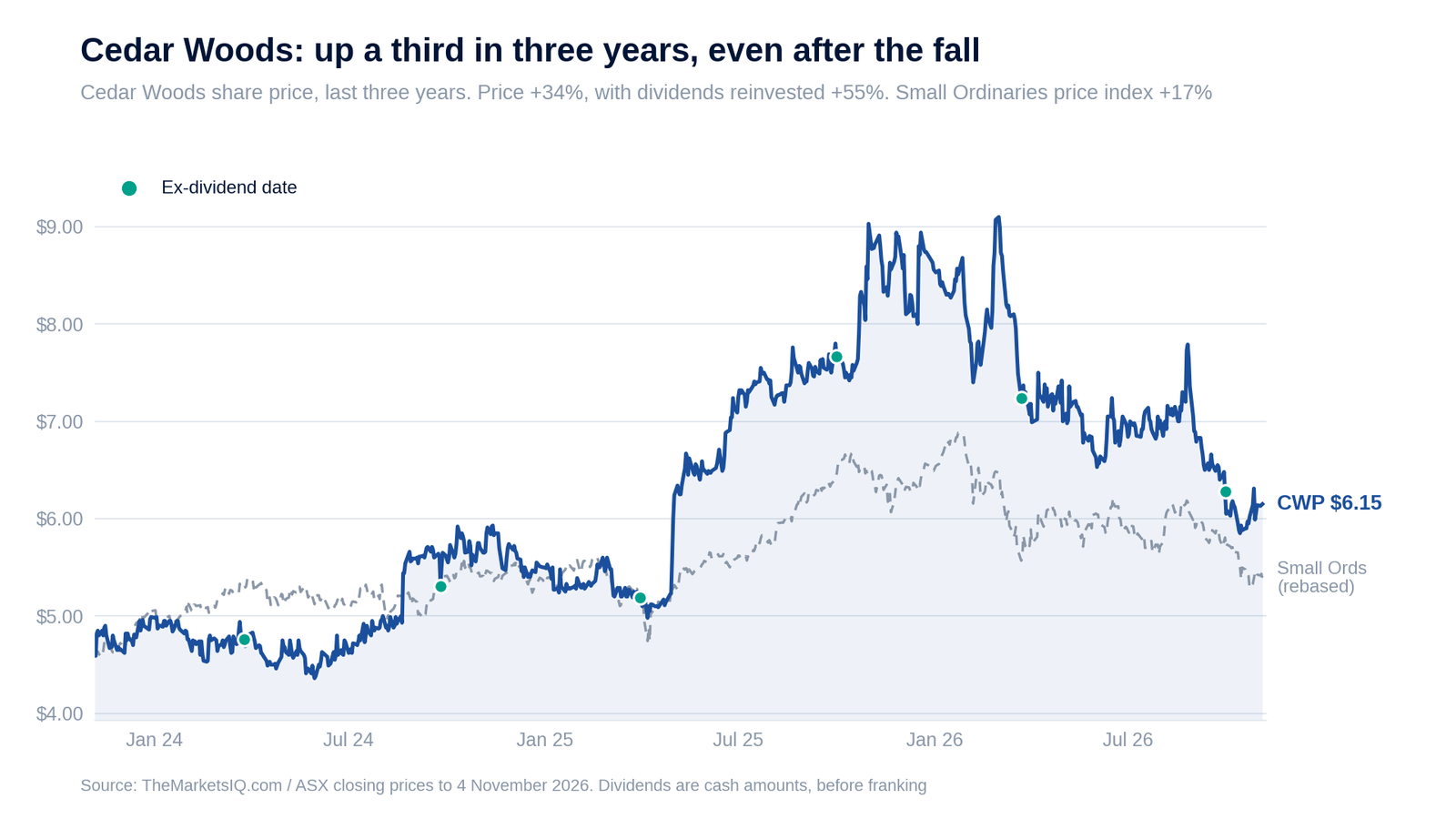
Over three years, Cedar Woods shares are up 34% on price alone and 55% with dividends reinvested, against 17% for the Small Ordinaries.
Next catalyst: the half-year result, expected in late February 2027. Cedar Woods reported on 24 February in 2026 and 19 February in 2025.
The second company sells a tax break you may already use.
McMillan Shakespeare (ASX:MMS), The Payroll Toll The Cash Rate Can’t Reach
McMillan Shakespeare (ASX:MMS) sits inside the pay packets of half a million Australians and New Zealanders.
Through Maxxia and RemServ, it runs salary packaging for employers. Staff pay some bills from their pre-tax salary, and McMillan does the paperwork. Its biggest earner is the novated lease, where an employee leases a car through their employer and the payments come out of their pay before tax.
In 2022 Parliament passed the Electric Car Discount law, which took fringe benefits tax off eligible electric cars. That made the novated lease a cheap way to drive a new EV. In FY26, battery electric vehicles made up 57% of McMillan’s new novated leases, up from 31% the year before.
McMillan is a toll booth on the payroll. Every pay cycle, the cars and the packages roll through.
90,000 Leases and a 62% Return on Capital
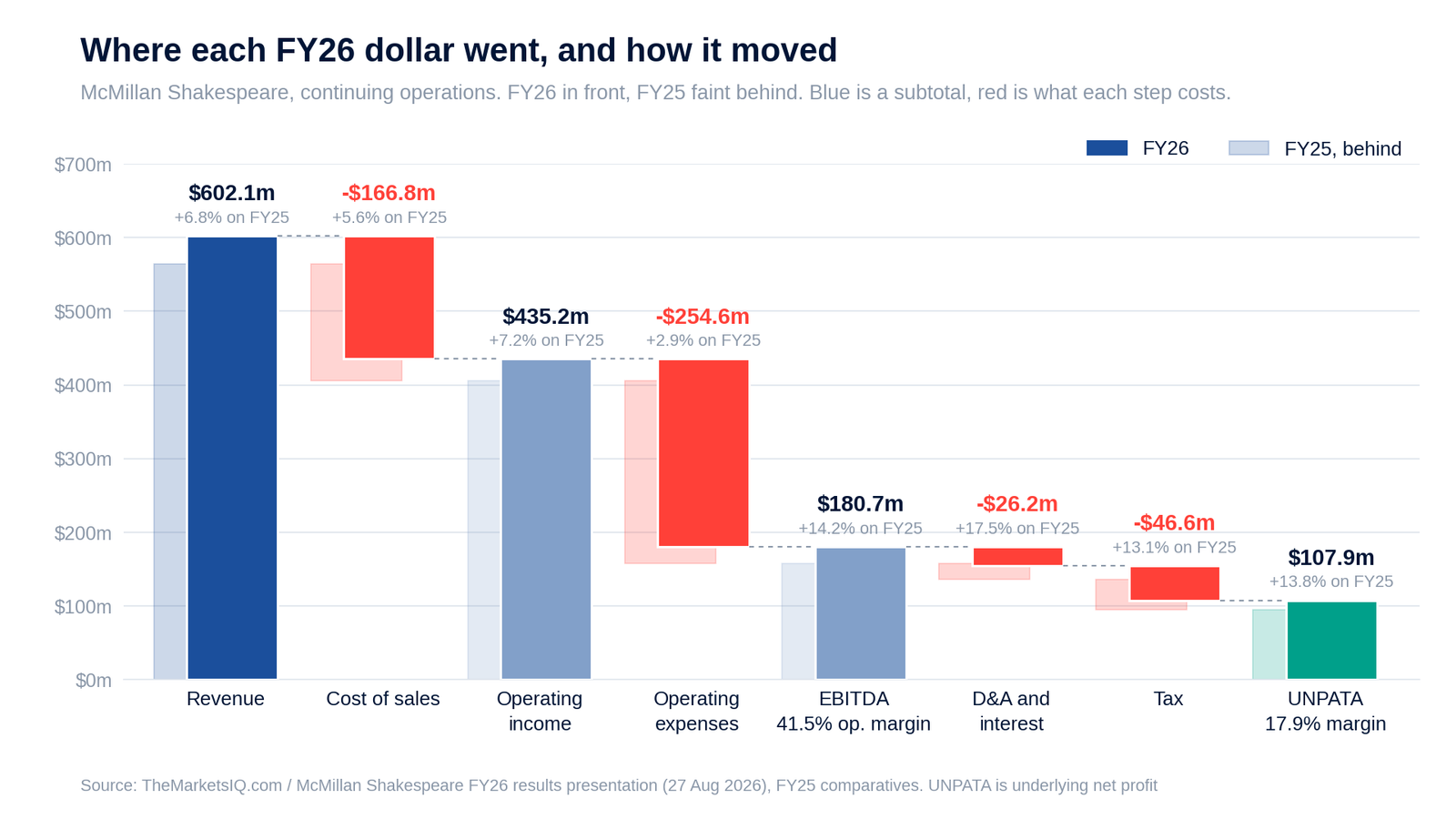
In FY26, revenue rose 6.8% to $602.1m. EBITDA rose 14.1% to $180.7m and the operating margin widened 2.5% to 41.5%. Statutory net profit rose 11.4% to $106.7m, and underlying earnings per share rose 13.8% to $1.55.
Novated leases under management rose 13.5% to a record 90,000. Salary packages rose 7.1% to 402,000.
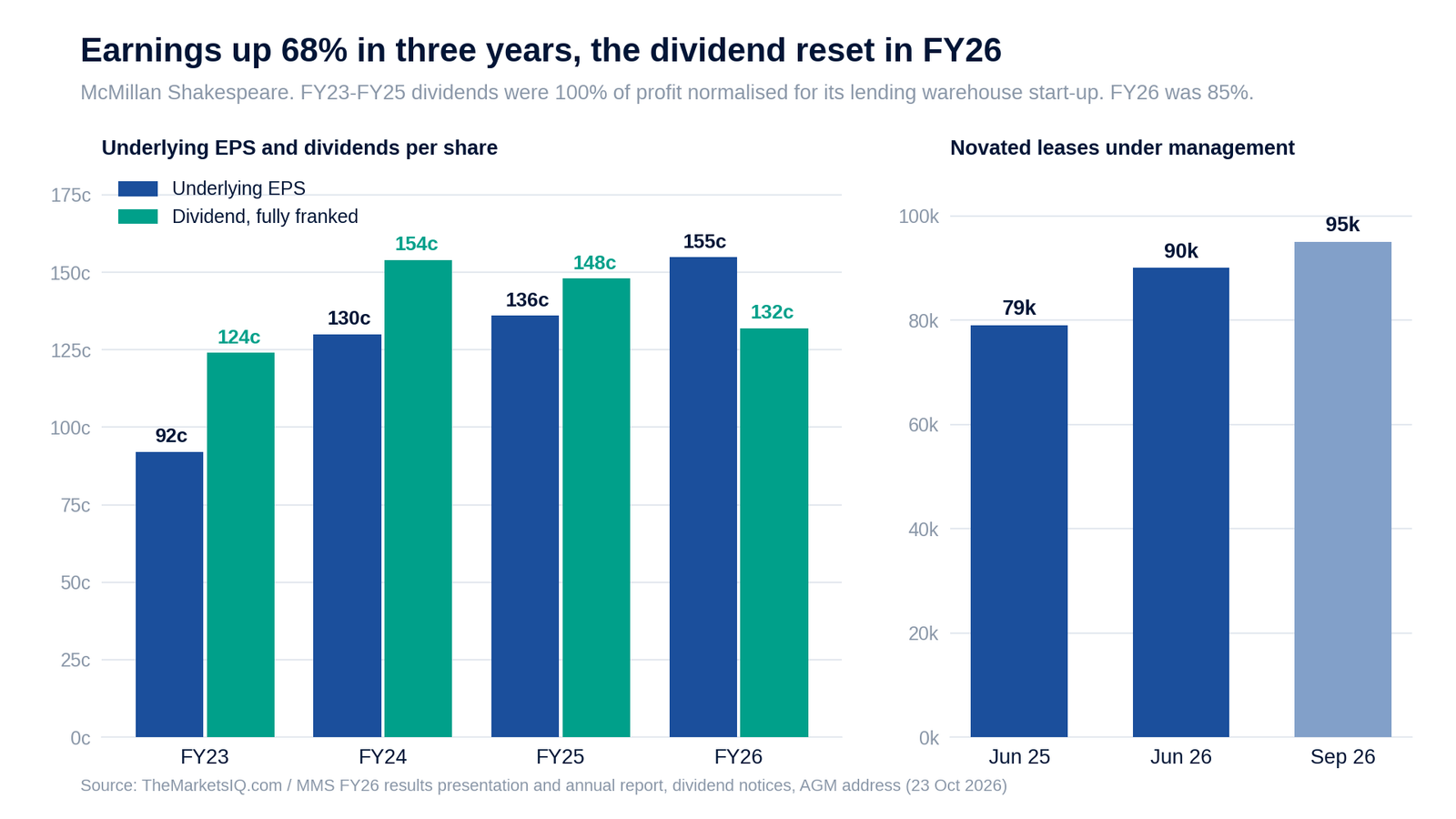
The return on capital employed was 62.1%. Debt sits at 0.4 times EBITDA, with no funding due in the next 12 months.
95,000 Leases, Up 17.5% in a Year
At the annual general meeting on 23 October, chief executive Rob De Luca gave a first-quarter update. Oly is McMillan’s novated lease brand for small businesses.
‘Demand for novated leasing remains strong with novated lease sales growing 14% on pcp. Oly sales were up 83% reflecting the continued success of our SME distribution strategy.’
Rob De Luca, CEO, AGM address, 23 October 2026
Novated leases under management reached 95,000, up 17.5% on a year earlier. Electric cars made up 75% of new novated sales in the quarter.
The $646,000 Rate Hike
Its annual report says a 0.25% move in Australian interest rates would have shifted FY26 profit by about $646,000. That’s about 0.6% of the $106.7m it earned.
Most of McMillan’s income is fees for running packages and leases. Where it funds leases itself, through its Onboard Finance vehicle and its fleet business, it hedges the interest rate with swaps.
Rates reach it another way. A higher rate makes each lease repayment heavier, and that can slow how many employees sign up.
Down 5.5% on Hike Day
On 3 November, McMillan fell 5.5% with no company news. Its closest listed rival, Smartgroup (ASX:SIQ), fell 8%. Market reports pinned the fall on the rate hike and on a 7-8% drop in oil overnight, which took some of the shine off electric cars.
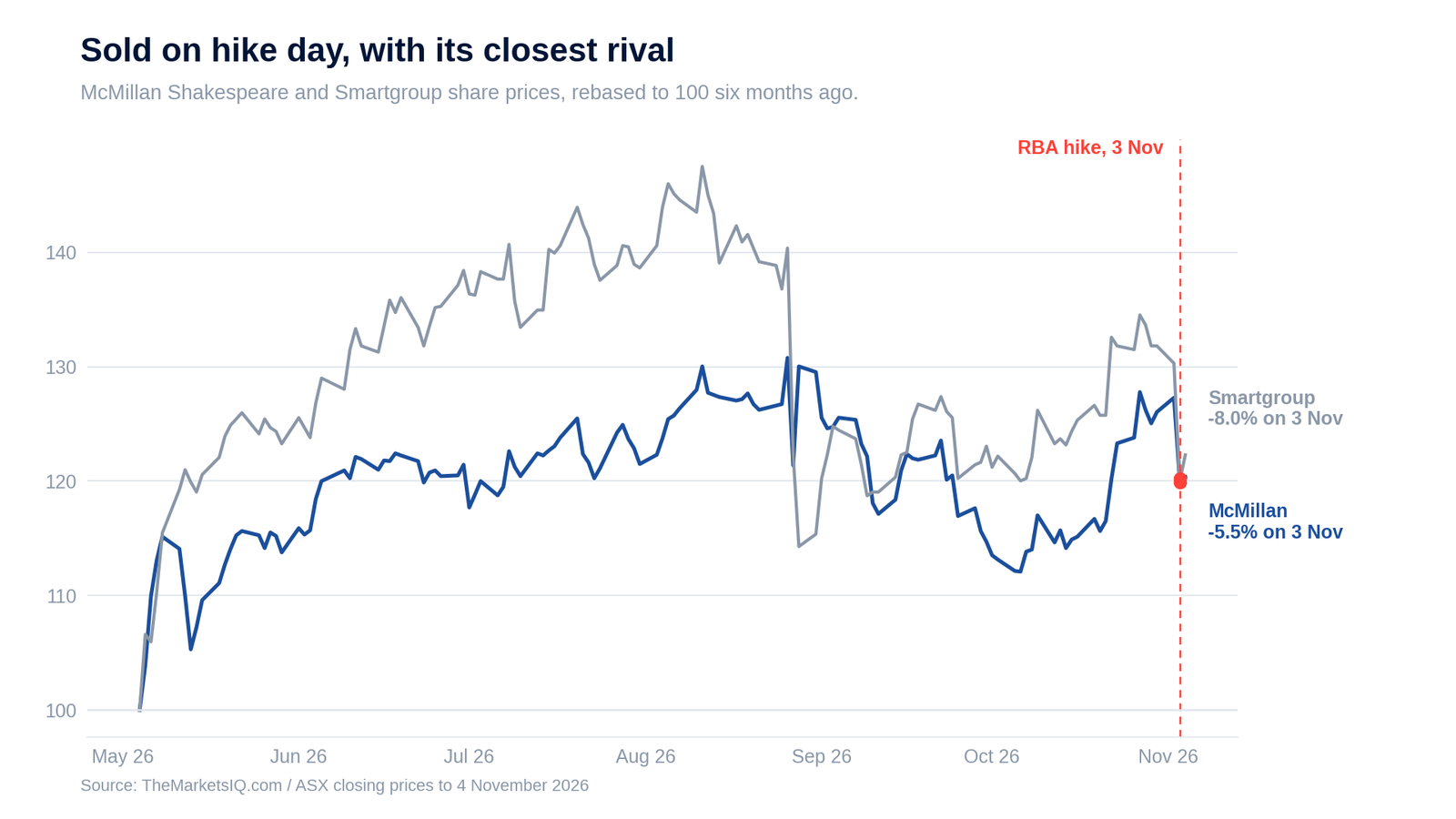
At $19.32, the $1.32 dividend is a 6.8% cash yield, or 9.8% grossed up. The shares trade on 12.5 times underlying earnings, 8% below their August high.
The Dividend Came Down So The Cover Could Go Up
The FY26 dividend of $1.32 is 10.8% lower than FY25’s $1.48, even though earnings rose.
For the three years to FY25, McMillan paid out 100% of underlying profit. In FY26 the board paid 85%, the midpoint of its 70% to 100% policy range. The interim fell from 71 cents to 62 cents and the final from 77 cents to 70 cents.
That leaves a buffer. If the board went back to the top of its range on FY26 earnings, the dividend would be about $1.55. That’s arithmetic on the company’s own payout policy, and it tells you how much room the board has before a bad year forces a cut.
The Risk Management Is Flagging
The biggest risk sits in Canberra. The FBT exemption for electric vehicles stays, with ‘phased modifications to the Legislation coming into effect in April 2027’, subject to the bill passing.
Management also flags falling profits from selling used cars.
‘Vehicle remarketing profits were down 15% on pcp, reflecting reduced used vehicle pricing and slower asset replacement cycles as customers continue to hold their vehicles for longer.’
Rob De Luca, CEO, AGM address, 23 October 2026
And the margin on each novated lease is thinner. ‘Novated yield is consistent with Q4FY26 and down 4% on pcp,’ De Luca said.
If McMillan goes on your watchlist, you’re betting electric cars keep the novated lease growing and Canberra leaves the tax break in place.
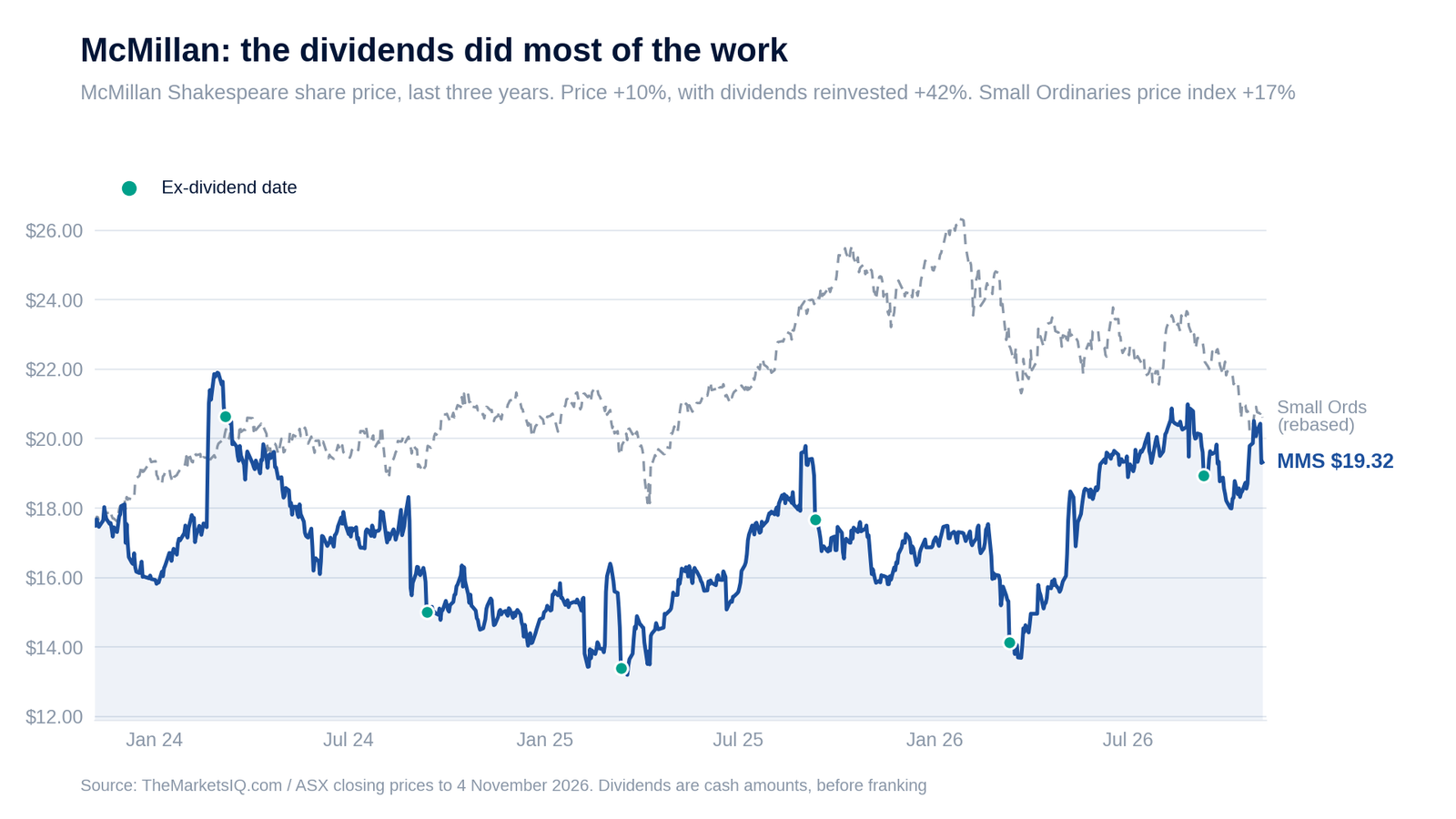
Over three years, McMillan shares are up 10% on price alone and 42% with dividends reinvested, against 17% for the Small Ordinaries.
Next catalyst: the half-year result, expected in late February 2027. McMillan reported on 23 February in 2026 and 27 February in 2025. Also watch the bill that makes ‘phased modifications’ to the electric vehicle tax exemption, due to take effect in April 2027 if it passes.
The Week’s Edge
Two dividend payers, two different defences against a fifth rate hike.
Cedar Woods has already written its FY27. More than 90% of this year’s revenue is contracted, and the market has marked the shares down 32% while guidance went up.
McMillan Shakespeare takes a fee from the payroll. A 0.25% rate move shifts its profit by less than 1%, and its board has already cut the payout to a level it can hold.
Neither is a bond proxy bleeding capital to fund its distribution.
Their engines differ. One runs on buyers coming back before FY28. The other runs on electric cars and a tax break.
Both are names for the watchlist, and each carries a risk you can put a number on. Cedar Woods wrote 57% fewer new sales in the first quarter than a year earlier, which would show up in FY28 if buyers stay away. McMillan depends on an electric vehicle tax break that Canberra plans to change from April 2027, and its dividend has already come down once.
So put three dates in your diary. The Reserve Bank meets on 8 December. Both companies report their half-year results in late February. And the electric vehicle tax changes are due in April 2027.
That’s when you’ll find out whether a split board means the last hike, and how these two dividends wear it.
Until next time, happy investing.
Izaac Ronay
Sign up to the Explosive Growth portfolio, and follow Izaac Ronay and The Markets IQ on LinkedIn.
Izaac Ronay is the Editor of The Markets IQ. He brings over 10 years of trading experience with top-tier global trading houses and 20 years of experience analysing and investing in ASX listed equities.
This publication has been prepared by The Markets IQ, a division of Vitti Capital Pty Ltd (ABN 13 670 030 145), which is a Corporate Authorised Representative (001306367) of Point Capital Group Pty Ltd (ABN 41 625 931 900), the holder of Australian Financial Services Licence 518031. This report is for general information only and does not take into account your objectives, financial situation, or needs. It is not personal financial advice or a recommendation to buy, hold, or sell any security. You should consider whether the information is appropriate in light of your circumstances and obtain professional advice before making any investment decision. This report is intended solely for wholesale, sophisticated, or professional investors within the meaning of the Corporations Act 2001 (Cth).
Any views, probabilities, valuations, technical levels, or forecasts expressed are strictly the opinions of the authors as at the date of publication, based on publicly available information and assumptions which may change without notice. They are illustrative only and not predictive of future outcomes. Past performance is not a reliable indicator of future performance.