

The market has priced your mortgage rise for 29 September 2026
This article is for general information only and is not personal financial advice.
The Reserve Bank meets on 29 September.
It’s almost certainly going to hike rates. Not because the RBA board wants to. But because the market has already given them the order.
If you don’t follow the RBA closely, that may surprise you.
Sure, they press ‘Enter’ on the decision button. But the most important thing is how the market is positioned leading into the meeting.
The RBA’s most important job is to guide the market. After all, a toddler can hit ‘Enter’ on a keyboard.
In fact, the RBA rarely goes against what the market has already decided.
Across the 131 board meetings from 2013 to 2025, the RBA moved the three-year bond yield more than 15 basis points on decision day just eight times.
And the market is firm on a September rate hike.
We’ll get into what a hike means for your portfolio.
But before that, we need to look at why the US could cause problems for Australia, and the 3.6 hikes the federal budget is handing us.
The Bond Market Moved First
Right now the market is signalling a hike.
The 30-day interbank rate is the main one to watch. The ASX RBA Rate Tracker is calling an 88% chance of a 25bp hike on Wednesday.
But there’s plenty of confirmation to be found.
The three-year government bond yield sits at 4.99%. The cash rate is 4.35%.
That 64 basis point gap points to at least two more quarter-point hikes over the next few years. Part of it is the extra return investors want for tying money up for three years, so it’s a strong signal with some noise in it.
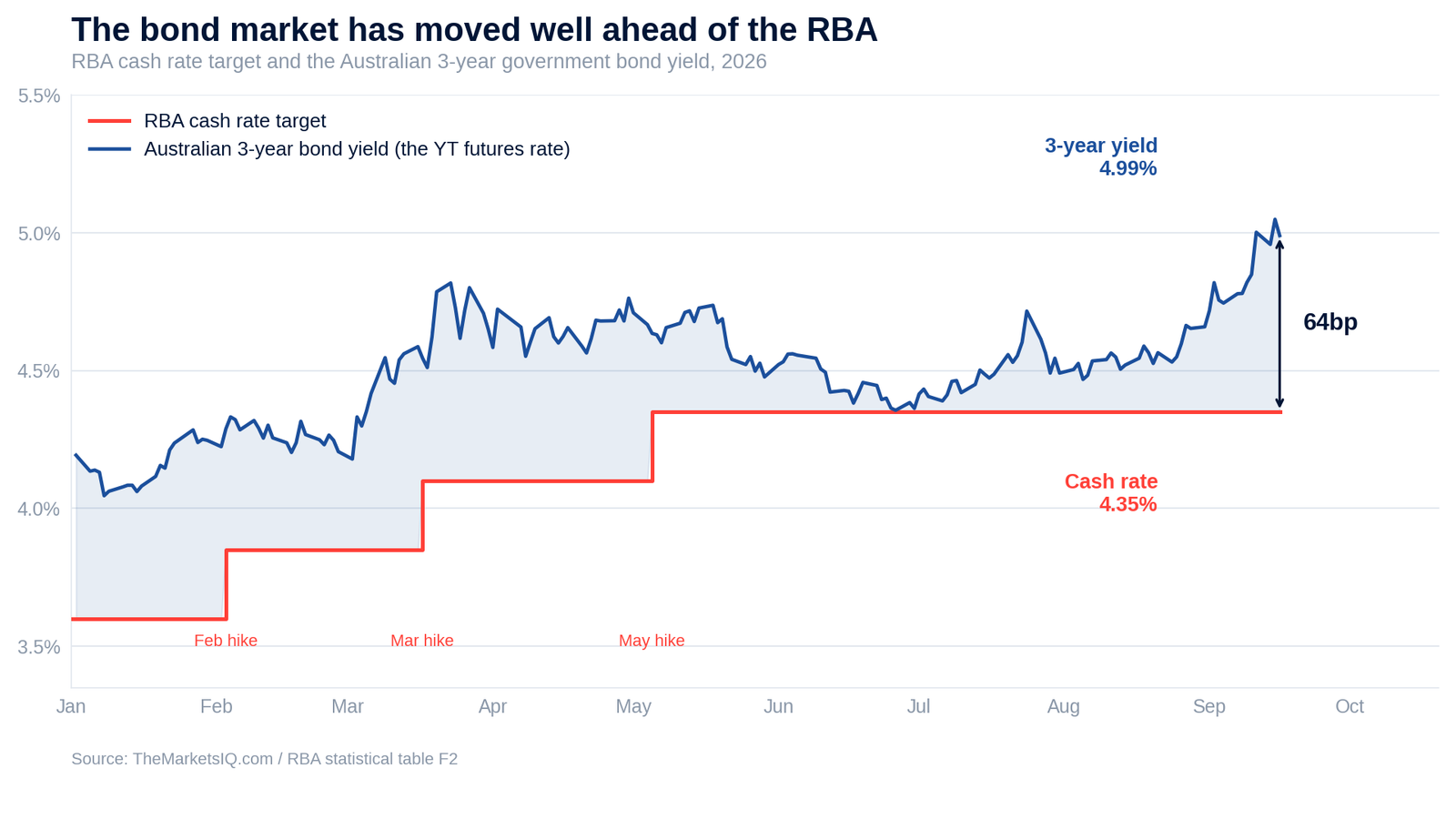
Between 30 June and 16 September, the three-year yield rose from 4.36% to 4.99%. No change in the cash rate drove that move.
The bank has lifted rates three times this year, in February, March and May, and the bond market priced each hike before the board delivered it.
The board has paused since May. The bond market is now pricing further hikes.
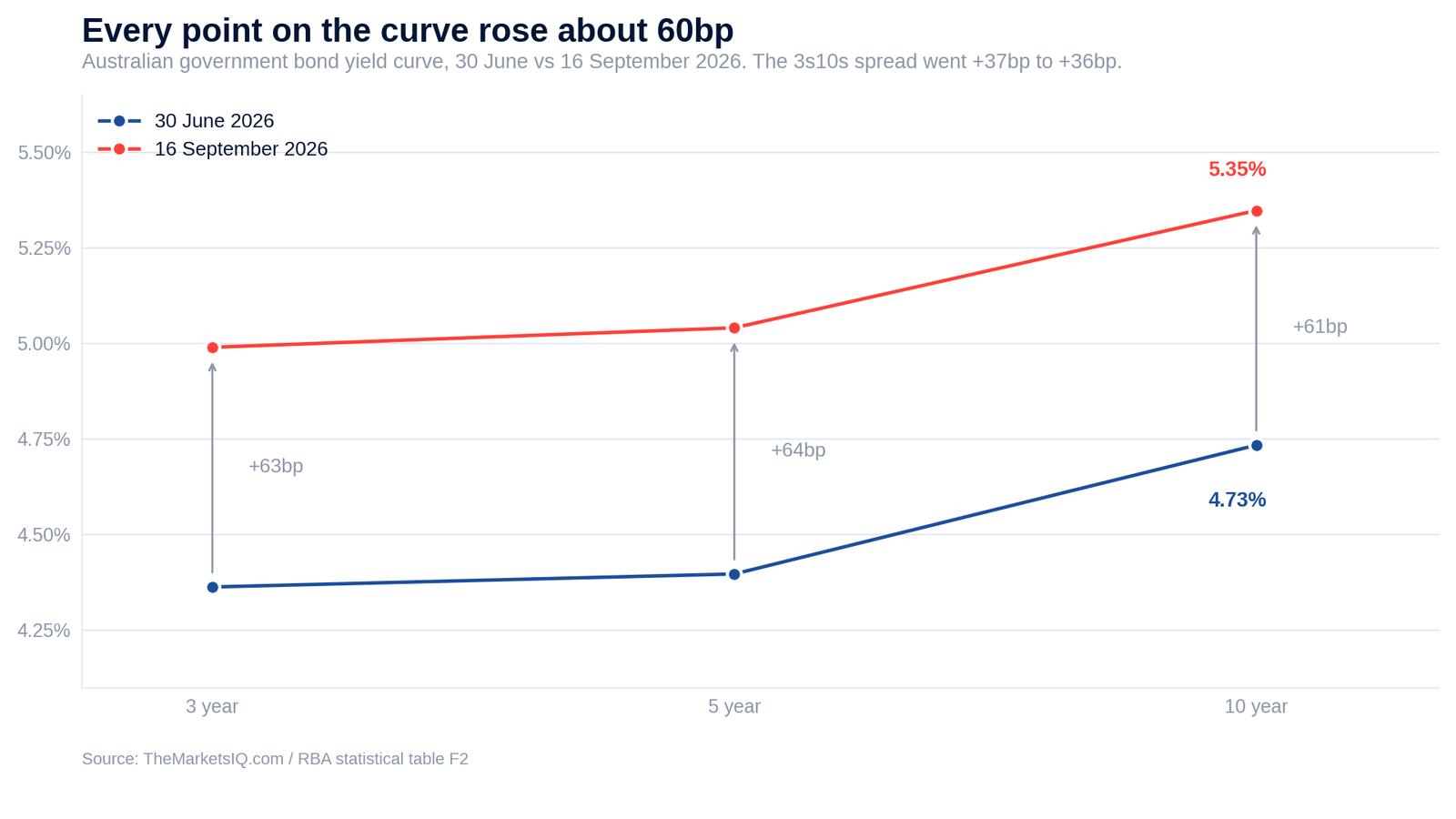
The move was broad. The five-year rose 64 basis points and the ten-year 61, while the gap between the three-year and the ten-year barely changed.
The shape of the curve tells you as much as any single maturity.
When markets expect a central bank to tip the economy into a slowdown, long-term yields can fall.
These rose with everything else, which reads as a market lifting its inflation forecast for years ahead. The ten-year hit 5.41% on 15 September, its highest in more than a decade.
Part of that pressure comes from overseas.
America Just Handed Us the Bill
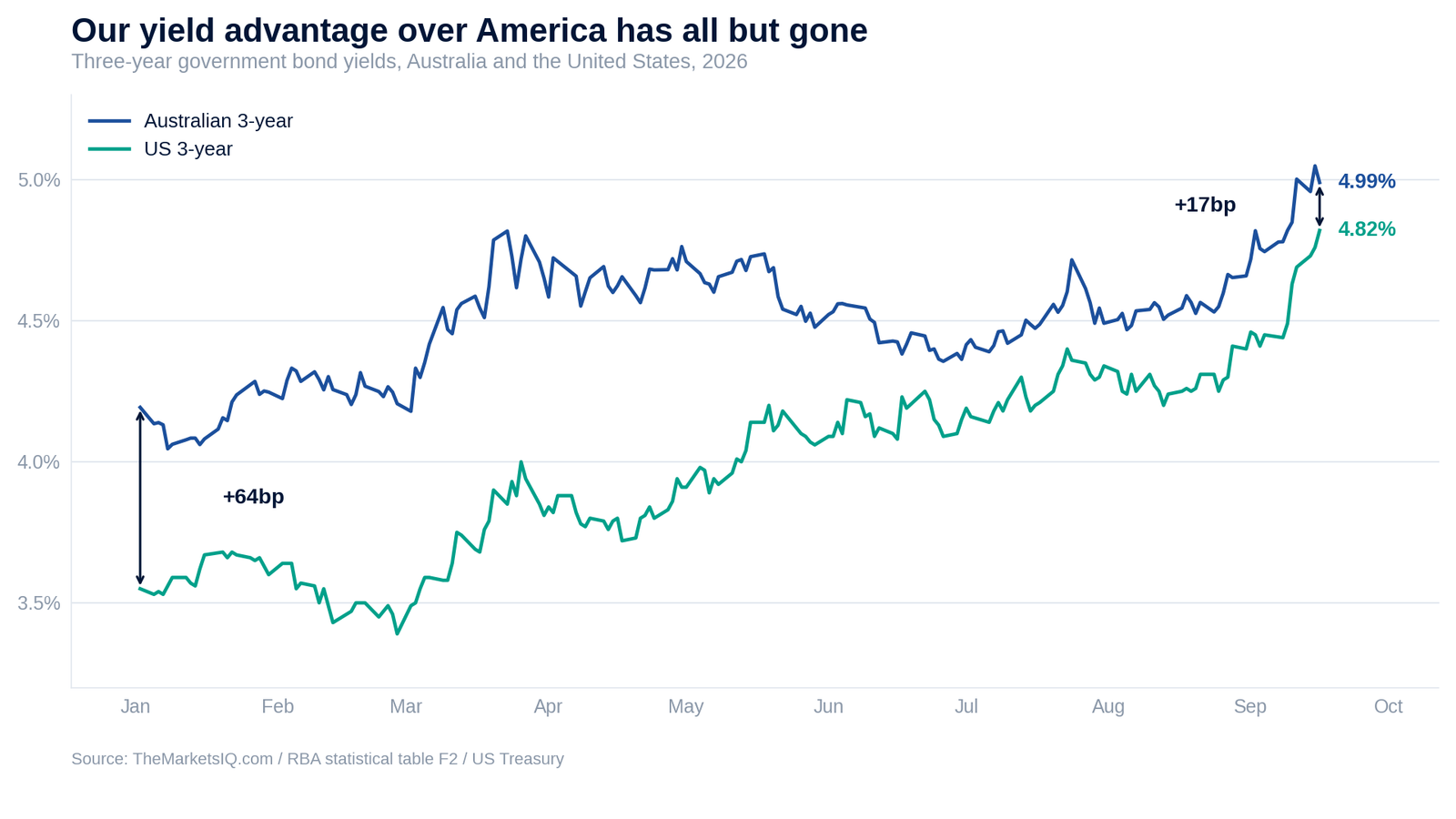
On 16 September the Federal Reserve raised rates for the first time since 2023, twelve votes to nil, taking its target range to 3.75-4.00%. Most officials pencilled in another rise this year.
Energy is doing the heavy lifting.
In June last year we told you the Strait of Hormuz carried 20% of the world’s oil, and that if it closed, prices would hit triple digits. Brent has traded between US$78 and US$126 since March and sits just under US$100 today. This is now showing up in wages, freight and power bills.
Kiss goodbye to the idea of transient inflation.
The Fed decisions directly impact our exchange rate.
In January our three-year bond paid 64 basis points more than the US equivalent. By 16 September that gap was 17.
A narrower gap tends to weaken the Aussie dollar, and a weaker dollar raises the cost of fuel, freight and anything else we import. That makes it harder for the RBA to sit still while the Fed moves.
The Pressure at Home
Inflation is easing. The CPI rose 3.5% over the year to July, down from 4.0% in May, and trimmed mean sits at 3.6%. The RBA’s August forecasts still don’t have inflation back to the middle of its 2-3% band until early 2028.
RBA Governor Bullock has warned that a tight labour market could exacerbate the flow through inflation of higher energy prices.
Households already hand over just under 12% of their disposable income in scheduled mortgage and consumer loan repayments, close to the 2024 peak.
The tax hikes unveiled in the recent federal budget take a slice of the same income.
Bracket Creep Is a Rate Hike Every Year
On current housing debt, a quarter-point hike takes roughly $6 billion a year out of household cash flow. That gives us a way to compare tax to interest rates.
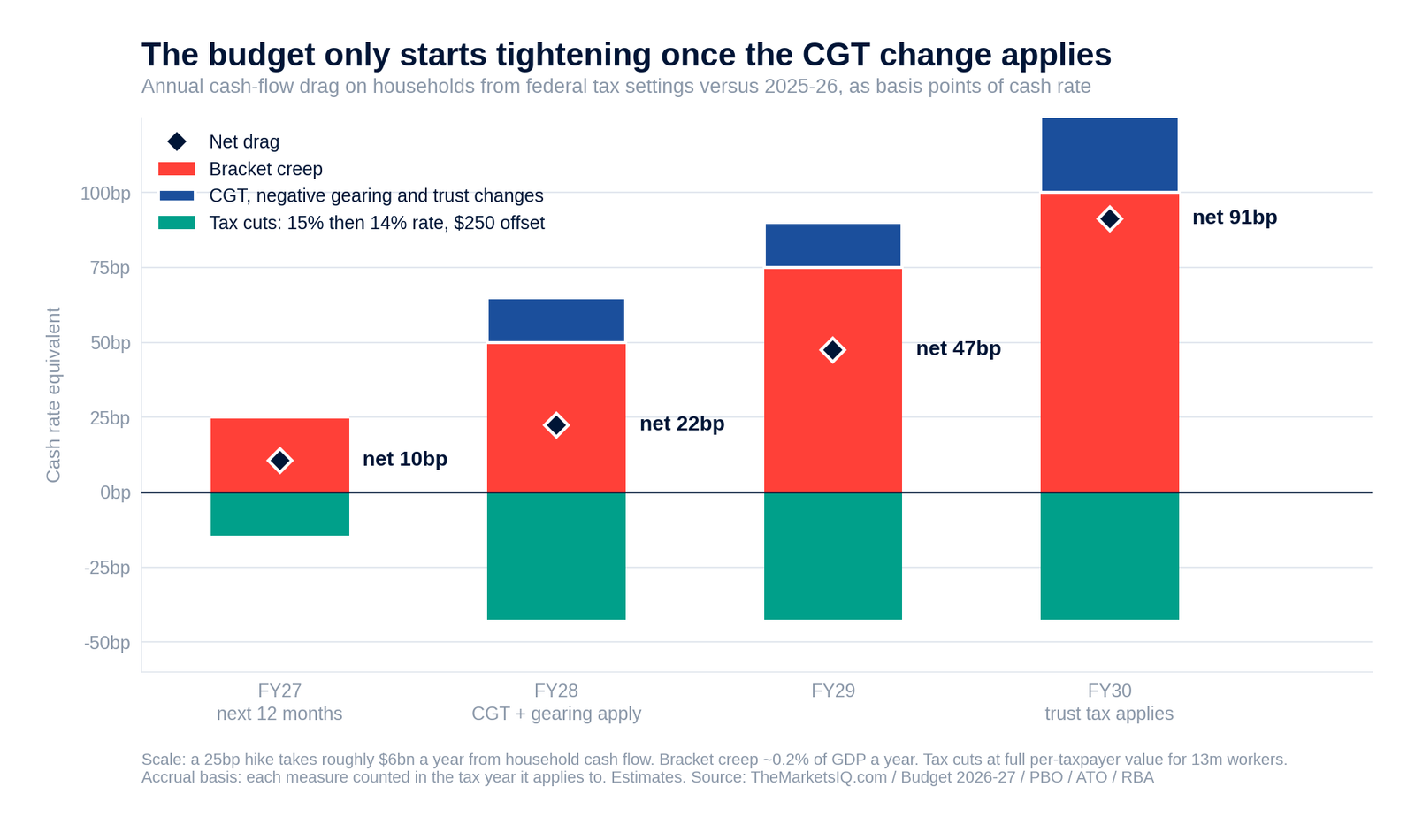
Bracket creep happens as wages rise and tax thresholds don’t, so more of each pay packet gets taxed at higher rates.
On Parliamentary Budget Office and Treasury numbers it runs at about 0.2% of GDP a year, or roughly $6 billion. That’s about one rate hike’s worth every year, collected through PAYG.
In the short term, Labor is handing most of it back.
The lowest tax rate, which applies to the $45,000 tax bracket, fell from 16% to 15% on 1 July. It drops again to 14% on 1 July 2027, when a $250-a-year offset also starts.
On our estimates, that returns about $3.5 billion in FY27 and about $10 billion a year from FY28.
Net, the budget has a similar effect on households to raising interest rates 10 basis points over the next 12 months.
The RBA Is on Its Own Until Mid-2027
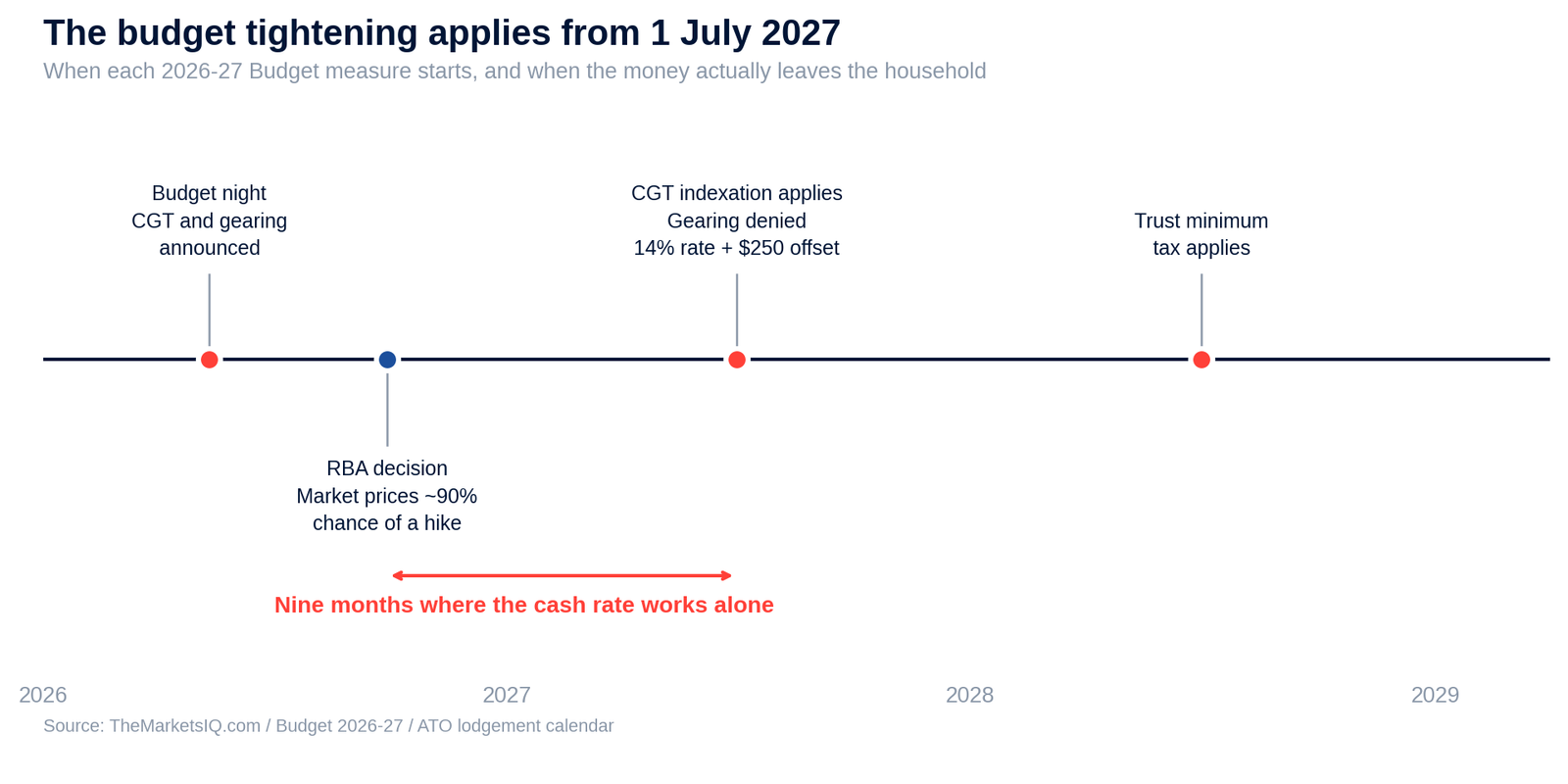
The bigger tax changes come later.
The CGT change and the negative gearing restriction apply from FY28. The trust minimum tax applies from FY29.
That more than doubles the drag to about 22 basis points in FY28, even with the bigger tax cuts arriving at the same time. On our numbers it then reaches about 47 basis points in FY29 and about 91 in FY30, if governments leave bracket creep alone.
In the early 1980s Paul Volcker tightened hard while Ronald Reagan cut taxes, and the two pulled against each other for years.
Former RBA Governors Glenn Stevens and Philip Lowe have both made the same argument. Stevens warned that governments were putting too much weight on monetary policy to achieve what it can’t. Lowe pushed for closer coordination between the two, and pointed out that when monetary policy carries the load alone, the cost falls on some households far harder than others.
Australia will have the budget and the RBA pushing the same way, but not until mid-2027.
Until the budget catches up, the cash rate will do damage to the household pocket. But it won’t be the end of it.
The Edge
Rate rises work through three channels, and each one hits a different part of the ASX, and often we’ll see a different impact across smaller stocks vs safer blue chips.
The first is the discount rate.
Money promised a decade from now is worth less as yields on safe debt rise, so the companies priced on distant cash flows get marked down hardest.
Watch growth tech, biotech, and commodity explorers and developers.
The second is household cash flow.
Mortgage repayments already take just under 12% of disposable income, and every rise takes more. Consumer discretionary is in the crosshairs.
The third is the capitalisation rate.
Property gets revalued as bond yields rise, which is why a REIT’s hedge book can become a major cyclical edge.
What holds up is the boring end.
Utilities. Boring.
Their revenue is contracted and often indexed to the thing causing the problem. Industrials. Some financials. Check our article on the yield rotation after the CGT change for a bit more edge.
Materials can be mixed, and it pays to think about specific commodities.
The US may be the nudge over the line for us to hike again in September. But the budget is bringing its own wall of pain over the next few years for investors.
There’s never been a better time to reassess your portfolio.
Until next time, happy investing.
Izaac Ronay
Sign up to the Explosive Growth portfolio, and follow Izaac Ronay and The Markets IQ on LinkedIn.
Izaac Ronay is the Editor of The Markets IQ. He brings over 10 years of trading experience with top-tier global trading houses and 20 years of experience analysing and investing in ASX listed equities.
This publication has been prepared by The Markets IQ, a division of Vitti Capital Pty Ltd (ABN 13 670 030 145), which is a Corporate Authorised Representative (001306367) of Point Capital Group Pty Ltd (ABN 41 625 931 900), the holder of Australian Financial Services Licence 518031. This report is for general information only and does not take into account your objectives, financial situation, or needs. It is not personal financial advice or a recommendation to buy, hold, or sell any security. You should consider whether the information is appropriate in light of your circumstances and obtain professional advice before making any investment decision. This report is intended solely for wholesale, sophisticated, or professional investors within the meaning of the Corporations Act 2001 (Cth).
Any views, probabilities, valuations, technical levels, or forecasts expressed are strictly the opinions of the authors as at the date of publication, based on publicly available information and assumptions which may change without notice. They are illustrative only and not predictive of future outcomes. Past performance is not a reliable indicator of future performance.