
Explosive Growth Portfolio Update September 2026
Bonds Are Up, Labor’s Raised Taxes Again. What’s Not to Hate?
General advice only. See full disclaimers below.
Global bond yields are pushing higher again, adding fresh pressure for more rate hikes around the world. The yen’s back playing cat and mouse with the carry trade unwind. Closer to home, investors are still finding their footing after Labor’s latest round of tax changes.
Put that together and you get an edgy market. Edgy markets throw up funny dispersions. Stocks and sectors go in wildly different directions for reasons that have nothing to do with the macro noise above.
Which brings us to the Explosive Growth portfolio. We’re going to dive into three names, with very different stories.
Regardless of what bonds, the yen or Canberra are doing, there’s always an interesting story in the market to tell.
Ballard Mining (ASX:BM1) — From One Deposit to a District
We first covered Ballard Mining (ASX:BM1) last October. One well-funded gold explorer, one deposit worth chasing.
Baldock.
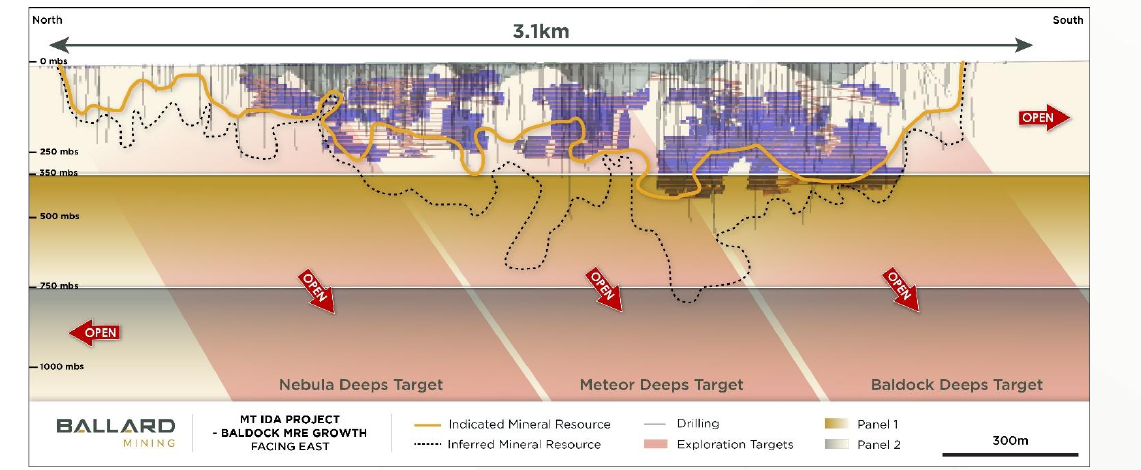
Figure: Long section of the Baldock Mineral Resource (Source: Ballard Mining ASX announcement, “Baldock Mineral Resource Exceeds 1 Moz”, 26 February 2026)
That deposit’s getting some serious gains.
Baldock passed 1Moz in February, the Indicated resource up 66% on an 86,000m infill program. Add the surrounding regional prospects and the Global Mt Ida resource sits at 1.2Moz across 12.3Mt.
In July, Ballard drilled its best hole yet with 9m at 27.1 g/t at West Knell, on a trend now running 3.7km to Neptune.
The project’s kept pace.
Metallurgical work is done to feasibility level, averaging 91% recovery. Geotechnical work is done across Baldock, Kestrel and West Knell. West Knell has its Mining Lease. Ballard’s fully funded to Final Investment Decision, and shareholders ratified that funding with 99%-plus support at a general meeting on 4 September.
Permits, cash, drill results. All pointing the same way.
Gold sat near US$3,950 an ounce when we first covered Ballard. It spiked past US$5,300 in January, dropped under US$4,000 by July, and now sits around US$4,330, close to flat since our last update on this stock.
Ballard’s share price is up around 5% over the same stretch. It’s the company doing the work, not the metal.
Watch for the Mt Ida resource update due later this year, feeding into a Definitive Feasibility Study, and the maiden ore reserve targeted for mid-2026.
Stakk (ASX:SKK) — Racing for Scale
Stakk (ASX:SKK)‘s chart looks nothing like its numbers.
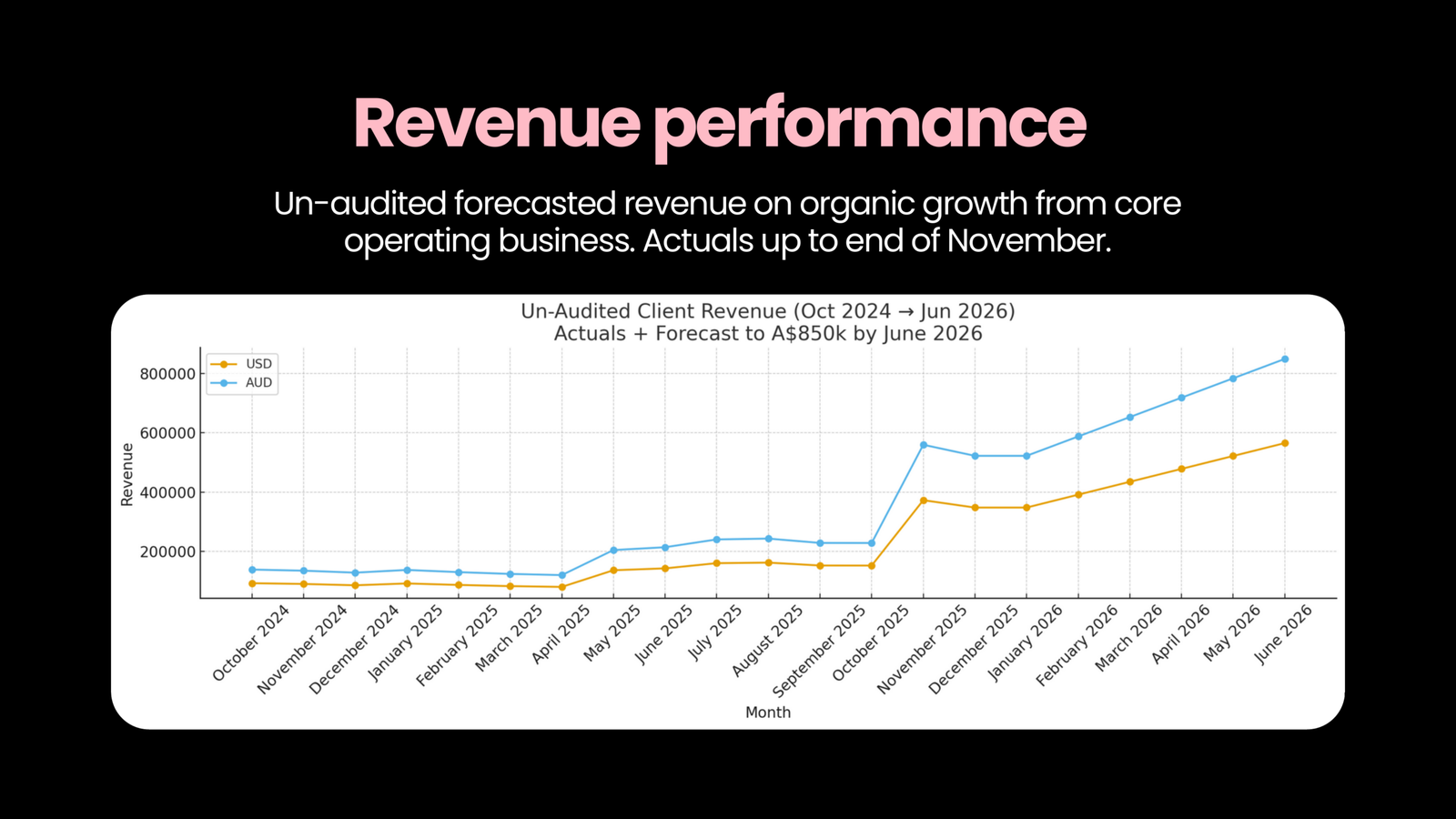
Figure: Un-audited client revenue, actuals plus forecast (Source: Stakk ASX-lodged Investor Presentation, December 2025)
FY2026 revenue grew 1,098% to $14.89 million. Operating profit came in at $1.07 million, against a $2.64 million loss the year before. Cash at year end: $17.57 million, up from $370,000 twelve months earlier.
That’s booked revenue. The signed-contract run-rate moved even faster: from $8.53 million in January to $26.0 million by June, backed by a $7.85 million enterprise contract in March and a further $3.85 million healthcare contract in June. Worth being precise about what that number is. A run-rate annualises current signed contracts, it isn’t revenue already recognised, and it can sit ahead of what actually lands in a given year while contracts ramp up. Stakk’s own standalone FY2027 guidance, given the same week as the $26.0 million figure, was a more conservative $21.8 million, based solely on contracts signed to date and assuming no further wins. The company hasn’t reconciled that gap publicly. We’d treat the run-rate as a leading indicator of demand, not a promise of FY2027 revenue.
Then, in July, it changed shape.
Stakk agreed to buy US-based ParaScript for US$63.0 million, a thirty-year player in AI document intelligence and fraud detection.
The deal adds over 100 billion digital interactions a year to Stakk’s platform, in a Digital Trust market management pegs at US$466 billion by 2032.
Combined pro forma FY2026 revenue went from $41.3 million in July to $45.0 million in August, before either company has captured a dollar of cross-selling or integration benefit.
Read our Synergies Explained for ASX Investors deep dive before you get excited about that upside. Stakk’s version looks more credible than most. Two document-intelligence platforms merging into one, in a market where scale is the best edge around.
It also puts Stakk itself in play.
A profitable, scaling platform with a US$63 million acquisition behind it, in a sector famous for consolidation, tends to attract attention rather than deflect it. Nobody’s put a number on the table. But the shape of this business now has strong potential to end up on somebody’s shopping list eventually.
Dilution hasn’t helped the share price. Funding the deal meant $27.0 million in new placement shares plus 1.18 billion consideration shares to ParaScript’s vendors. That’s a lot of new stock landing at once.
The business is bigger and more profitable than in December. The share count is bigger too, and the market’s still working through it. The $21.8 million standalone guide is superseded now anyway. ParaScript folded in pushes the combined FY2027 target to $55.2 million revenue and $18.5 million EBITDA. Whether that catches up to the dilution is the question.
As we publish this, SKK is in a trading halt, requested on 14 September pending the final steps to complete the ParaScript acquisition. Trading resumes by the open on Thursday 17 September at the latest, or sooner if the completion announcement lands first. The first post-completion quarterly is what will show whether the integration is delivering on the numbers management has promised.
Actinogen Medical (ASX:ACW) — A Coin Flip Worth Billions
Actinogen Medical (ASX:ACW) is up since we first covered it in January, and it’s moved faster in the last fortnight than in the seven months before it.
Here’s why. ACW’s XanaMIA trial, a Phase 2b/3 study of Xanamem in 247 Alzheimer’s patients, reports final results in November.
The signals into that readout are better than most binary biotech bets get.
Three Independent Data Monitoring Committee reviews have cleared the trial to continue without changes, including a January review of unblinded efficacy data, not just a safety check.
Eighty-nine per cent of finishing participants rolled straight onto the open-label extension. ACW’s already aligned with the FDA and EMA on the path to approval.
The prize could be enormous if all goes to plan. Alzheimer’s has a handful of approved treatments and none that meaningfully shift its course. A positive readout could reposition the company entirely overnight.
Here’s the scientific case underneath that bet. Elevated brain cortisol is linked to faster Alzheimer’s progression, and it’s not a fringe theory. Mean CSF cortisol levels rise in lockstep with disease severity, from cognitively normal through to AD dementia, in the peer-reviewed AIBL cohort data below.
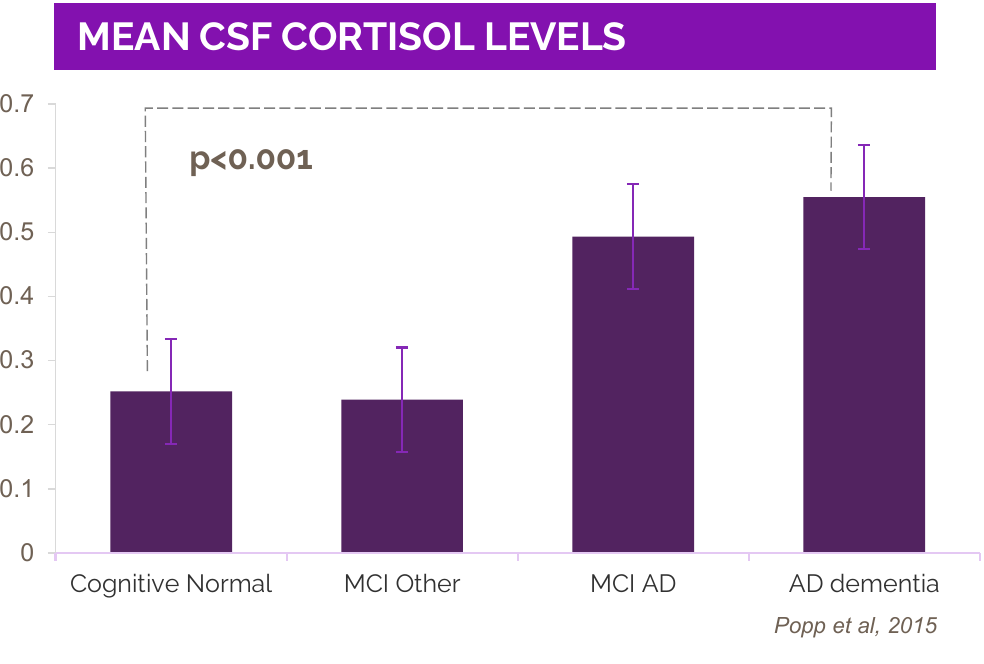
Figure: Mean CSF cortisol levels by cognitive status (Source: Actinogen Medical ASX-lodged Corporate Presentation)
Xanamem is built to blunt that cortisol signal in the brain. That’s the rationale. November tells us whether it translates into a clinical result.
But…there’s always a ‘But’.
Clinical trials have a nasty habit of failing, including plenty that looked this promising going in. Our Clinical Trials: The Stages and What to Look For deep dive runs the base rates by phase.
Worth reading before November lands.
ACW’s cash balance of $16.7 million funds it through to mid-2027, whichever way the trial goes.
For the full recommendation and technical review on Actinogen Medical, sign up for the free members section of the website here.
Catalysts & Risks
Catalysts
- BM1: Global Mt Ida resource update (H2 CY2026) feeding into a Definitive Feasibility Study, and the maiden ore reserve targeted for mid-2026
- SKK: ParaScript completion (trading halt lifts by 17 September at the latest) and the first post-completion quarterly
- ACW: XanaMIA Phase 2b/3 topline trial results, due November 2026
Risks
- BM1: a reversal in the gold price would remove a tailwind even though the project itself isn’t relying on one
- SKK: further dilution, and Stakk’s own $26.0 million run-rate versus $21.8 million FY2027 guidance gap remains unreconciled
- ACW: most clinical trials fail, including ones with promising interim signals — November is a binary event
Summary
Ballard’s de-risking with drill bits and permits, not the gold price. Stakk’s betting scale wins in Digital Trust, paying for it in dilution today against a bigger business tomorrow. Actinogen’s whole story hits a big moment of truth come November.
And November’s close.
For the full recommendation and technical review across the portfolio, sign up for the free members section of the website here.
This publication has been prepared by The Markets IQ, a division of Vitti Capital Pty Ltd (ABN 13 670 030 145), which is a Corporate Authorised Representative (001306367) of Point Capital Group Pty Ltd (ABN 41 625 931 900), the holder of Australian Financial Services Licence 518031. This report is for general information only and does not take into account your objectives, financial situation, or needs. It is not personal financial advice or a recommendation to buy, hold, or sell any security. You should consider whether the information is appropriate in light of your circumstances and obtain professional advice before making any investment decision. This report is intended solely for wholesale, sophisticated, or professional investors within the meaning of the Corporations Act 2001 (Cth).
Any views, probabilities, valuations, technical levels, or forecasts expressed are strictly the opinions of the authors as at the date of publication, based on publicly available information and assumptions which may change without notice. They are illustrative only and not predictive of future outcomes. Past performance is not a reliable indicator of future performance.
Directors, staff, or clients of Vitti Capital — including the author of this report — may hold positions in Ballard Mining (ASX:BM1), Stakk (ASX:SKK) or Actinogen Medical (ASX:ACW), or related securities, at the time of publication. Such holdings may change without notice. Vitti Capital applies internal controls to manage potential conflicts of interest; however, readers should assume that conflicts may exist.
The analyst(s) responsible for preparing this research note certify that the views expressed in this report accurately reflect their personal views about Ballard Mining (ASX:BM1), Stakk (ASX:SKK) and Actinogen Medical (ASX:ACW) and their securities. No part of their compensation is, or will be, directly or indirectly related to the specific recommendations or views expressed herein. The analyst(s) and/or their associates may hold an interest in Ballard Mining, Stakk or Actinogen Medical.