

ASX Robotics Stocks: The Good, the Bad and the Ugly
The Brain Is Solved. The Body Is the Business.
This article is for general information only and is not personal financial advice.
BMW is paying about US$25 an hour to rent a robot.
Forty of them work at the Spartanburg plant in South Carolina. They’re Figure 03 units, billed by the robot-hour like a labour-hire firm bills a casual. They earned that contract by helping build more than 30,000 cars during the pilot.
The robots aren’t just a demo any more. They’re leaving the cave, and heading for our homes and factories. Not to mention our warzones. Defence is shaping up as one of the great enablers of robotics advancement.
The robotics story has been unfolding since the industrial revolution at a snail’s pace. In the last few years the whole recipe has changed.
Back in August, in The ASX Earnings Season Setup, I promised we’d come back to robotics. Here we are.
We’ll get into how the ASX is positioned for this emerging wave of innovation, but first, let’s look at what changed, and why now is the time to sit back and have a think about it all.
The Brain Arrived While Everyone Was Watching Chatbots
Industrial robots have been competent since the 1970s.
Put one on a production line and it’ll weld the same seam ten million times without complaint. Move the seam two centimetres and it welds thin air.
That was robotics. Enormous strength, perfect repetition, no judgement.
The missing piece was generalisation. A robot that has never seen your kitchen has to work out what a cup is, where it is, that it’s full, and how hard to squeeze it. Every attempt to hand-code that failed.
Then the vision-language-action model showed up.
Google’s Gemini Robotics more than doubled the score of the previous best models on a benchmark built to test situations the machine had never trained on. Physical dexterity advanced alongside it, with machines learning to improve themselves through practice.
Both moved in leaps and bounds in 2026.
The robot borrowed the language model’s world knowledge.
It can now watch, reason and act in a room it’s never entered. Not perfectly. But well enough to sell.
We made the productivity case for all this in The AI Productivity Superstorm, back when the machines were still trapped behind glass.
Which brings us to the uncomfortable bit. Once you can think, you still have to move.
I think, therefore I am. I move, therefore I do.
A Humanoid Is a Pile of Expensive Joints
Fancy pieces of metal can get expensive.
Fifty-five thousand US dollars. That’s the bill of materials for a full-size dexterous humanoid of the Tesla (NASDAQ:TSLA) Optimus Gen 2 class.
Actuators are about 56% of it.
Not the compute. Not the cameras. The joints.
The hands alone run to US$9,500, because dexterity means cramming small actuators into a small space. The legs come to roughly US$21,000.
The battery pack is US$300. Less than the shipping.
Every rotary joint needs a precision reducer. Small joints use harmonic drives, strain-wave gearboxes machined to tolerances only a handful of firms on earth can hit. The big load-bearing joints need something tougher. Lead times are running 26 weeks and longer.
The firms that have driven the cost down hardest are Chinese. Tesla buys its harmonic reducers from Suzhou Green Harmonic at 30-50% below the incumbents, and one analysis this year concluded that stripping Chinese parts out of Optimus would roughly triple its cost.
If that pattern feels familiar, it should. We traced the same chokepoint on the magnet side in Rare Earth Elements: Seventeen Metals, One Chokehold.
Intelligence is shaping up to be just another download.
The body is the real battleground, and the supply chain rhymes with Shenzhen.
The Scoreboard Is Smaller Than the Noise
This is still a young industry, but don’t be fooled. Our lives are about to change.
The Robotic Revolution!
Global humanoid shipments in the first half of 2026 came to about 19,100 units. Chinese manufacturers took more than 97% of them.
Unitree has produced around 18,000 robots in its history and shipped 5,900 in the first half alone. Tesla has an estimated 1,000 to 1,200 Optimus units working inside its own factories and has sold none to anyone else.
Nineteen thousand machines.
A footnote.
An experiment. But with mammoth potential.
So where does the ASX fit?
Thinly, and awkwardly. We have no listed pure play worth the name. There are a handful of hopefuls, but the economics are rough so far.
I’ve called this the good, the bad and the ugly. I’m not going to tell you which is which.
Partly because reasonable people can disagree.
Mostly because the machines are learning to read, and I’d rather not end up on a list.
FBR Ltd (ASX:FBR): Proven, In Theory
FBR Ltd (ASX:FBR) built a robot that lays bricks.
Hadrian X works off a CAD model, lays large blocks at a designed rate of 360 an hour with a rated top speed of 500, and back in 2018 put up the structure of a three-bedroom, two-bathroom house in under three days.
It applies its own construction adhesive as it goes, and its Dynamic Stabilisation Technology measures boom sway and wind in real time and counteracts them, which is the hard part.
The technology is genuinely impressive. Watch the footage and you’ll wonder why every developer in the country isn’t queuing up.
Then you look at the commercial reality.
FY26 revenue was $551,558, down 58% on the prior year, and a loss after tax of $7.7 million. The market values the whole company near $21 million.
Two hurdles explain the gap between the demo and the unfathomable riches some investors started counting too early.
The first is capital.
Each machine is a truck-mounted 32-metre telescopic boom of steel, aluminium and carbon fibre composite, able to build three storeys from the roadside, and somebody has to fund a fleet of them before the economics work.
Robots don’t scale like software. Every unit costs real money and takes real time.
The gross profit on that $551,558 of revenue was $22,897. That’s about 4% in a capital-intensive industry. Those numbers don’t work. At least not yet.
The second is the quiet part that no one wants to say out loud.
Bricklaying is unionised, well organised and politically sensitive. A machine that removes the trade from the site doesn’t just need to be better and cheaper. It needs to survive the enterprise agreement, the site delegate and the client who’d rather avoid the argument altogether.
Great technology can be commercially inert for a very long time.
FBR has spent more than a decade proving that. In July it pushed through a 50-to-1 consolidation, collapsing 6.9 billion shares into about 139 million. It has been funding itself with convertible notes, and shareholders meet on 23 September to ratify those issues and approve the shares that will be created when the notes convert.
That’s a sentence worth reading twice if you own it.
FBR has branched out beyond bricklaying, with Mantis for automated welding and Firehawk for autonomous refractory relining. The first Mantis has been pre-sold to a customer in Louisiana.
The tech is interesting. The financials right now are, well, let’s say not pretty.
VEEM (ASX:VEE): Cyclical, With a Submarine-Shaped Option
VEEM (ASX:VEE) out of Perth is an old-fashioned Australian engineering business. It designs and manufactures marine propulsion systems and large gyrostabilisers, the units that stop a boat rolling (obviously!).
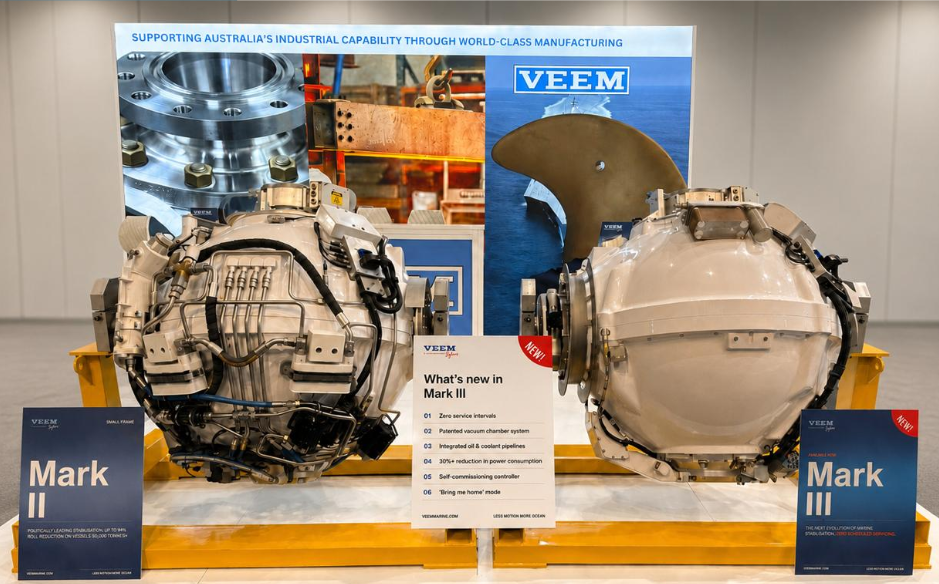
FY26 was rough. Revenue fell 25% to $51.7 million and the company posted a net loss after tax of $17.8 million, against a $3 million profit the year before. Most of that swing was a one-off, non-cash impairment of $24.8 million against the gyro program.
Before you read that as a failed product, read why it happened.
Gyro revenue fell $9.5 million because the marine market stopped. VEEM sold no gyros at all in the first half. Missing budget by that much triggers an impairment test, the test was run, and the write-down followed.
The machine didn’t stop working. The buyers stopped buying.
It’s tough work roboting on the ASX.
That distinction tells you what kind of business this is. Gyros and propellers go to superyachts, fast ferries and commercial workboats, which is about as discretionary as heavy equipment gets. Nobody re-props a pleasure vessel when credit is tight and the boat can wait another season.
So the fall lands where the cycle lands. Gyro was well over half the revenue decline. Non-defence propulsion sales of $24.9 million were down only 7%.
The second half tells a different story to the headline. Revenue of $28.3 million was up 21% on the first half, EBITDA improved by $4 million between the halves, and operating cash flow rose 64% for the year. Management says the marine recovery held into the first quarter of FY27.
Net debt sits at $1.2 million after a capital raise. The market caps it near $80 million.
This is a cyclical manufacturer, and cyclicals look worst at the bottom.
Here’s where it gets interesting. VEEM describes itself as an Australian defence manufacturer, and the second-half recovery was driven by defence workloads, specifically the submarine refit program and accelerating deliveries into ASC orders.
A submarine is, when you strip the romance out of it, a very large robot. OK, so not really. But there are transferable concepts at least.
It’s a sealed autonomous-capable platform that has to move precisely, stabilise itself, manage vibration and survive an environment that would kill everything on board. The engineering disciplines that make a gyrostabiliser work are the disciplines that make big machines behave.
If large-format robotics and autonomous marine platforms are where Australia ends up participating, VEEM has the foundry, the machining capability and the defence accreditation already.
And if that thesis takes another five years to arrive, there’s AUKUS.
The pact has survived more predicted deaths than John Farnham farewell tours. If it holds, and submarines get built and maintained in this country, a Perth engineering firm with existing ASC relationships is in a reasonable spot.
Cross your fingers. Cross them twice.
Nabtesco (TSE:6268): The Boring One That Gets Paid
Remember that handful of firms on earth?
Nabtesco is one of them. And it’s the biggest. It makes an estimated 60% of the world’s RV reduction gears, the heavy-duty units that sit in the big load-bearing joints of industrial robots.
Between Nabtesco and its compatriot Harmonic Drive Systems, which owns the strain-wave side, two Japanese companies supply roughly three-quarters of the world’s precision reducers.
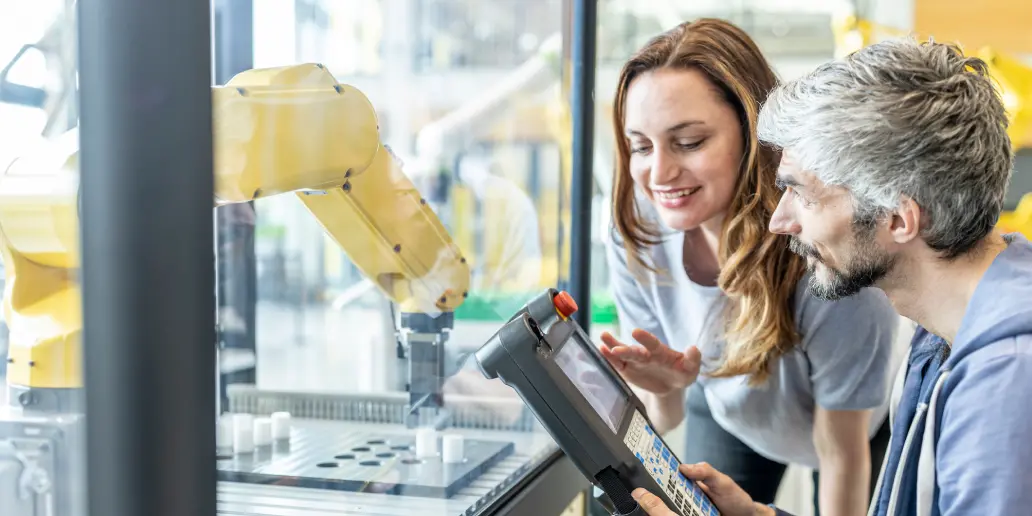
Every robot arm you’ve seen in a car plant, from Fanuc, ABB, Kuka or Yaskawa, has a reducer in each joint. A majority of those come from one Japanese company that almost nobody in Australia has heard of.
Nabtesco doesn’t build robots. It sells the part that makes robots possible, to everyone, including the people trying to put each other out of business.
Nabtesco sells the picks and shovels of the Robotic Revolution.
The first half of FY26 brought revenue of ¥167.4 billion, up 17%, and operating profit of ¥15.8 billion, up 72%, at a 9.5% margin. Management lifted full-year guidance to ¥344 billion of revenue and ¥32.6 billion of operating profit, raised the dividend to ¥82 a share, and announced a buyback of up to ¥15 billion.
Profit. A dividend. A buyback.
The market caps it near ¥515 billion, roughly $4.5 billion.
The shares trade around ¥4,449 on about 28 times earnings, with a 1.9% dividend yield. Up 43% over the year, and still 27% below their 52-week high of ¥6,113.
Reducers are only part of the business. Nabtesco also makes railway brakes, aircraft actuators, automatic doors and marine controls. If humanoids take another decade to arrive, the trains and the doors pay the bills in the meantime.
And it isn’t sitting still. It’s doubling precision reducer capacity in anticipation of humanoid demand, and in 2023 it bought Spinea, a Slovak cycloidal reducer maker, to deepen the position.
Now the part you need to hear.
The Chinese are coming for this niche.
Leaderdrive already holds 30-40% of China’s harmonic reducer market. Shuanghuan Driveline supplies both Optimus and Unitree and is opening a Suzhou plant reported at 500,000 reducers a year. That is a direct assault on the highest-margin component in the machine.
A robotics business that is profitable today, diversified enough to wait, and sitting on the industry’s tightest chokepoint. That combination is rare.
The Edge
Robotics plays on the ASX tend toward the high risk, commercially unproven speculators. It’s not our strength.
That’s despite some cutting-edge technology developed right here. The big challenge is the sky-high cost of physical components, and actuators most of all.
Which is the real lesson of this piece.
The intelligence problem is largely solved. The manufacturing problem is wide open. And the money in a gold rush has always been less reliable in the claims than in the picks.
Australia gives you two interesting stories and no survivors. FBR (ASX:FBR) is brilliant engineering delivering a horrific 4% gross margin. They desperately need scale. The best option is a well-funded commercialisation partner.
VEEM (ASX:VEE) is a decent cyclical business with a defence option attached.
Neither is a bad thing to own at the right price. Neither is a sure thing.
If you want the part of this you can hold through a downturn, you have to leave the ASX and buy the chokepoint.
The deepest pockets in the meantime belong to defence budgets, and that’s the funding source to watch as the industry develops.
Brilliant technology is not a business until someone can afford it.
The robots can think now. Everything from here is metal, tolerance and patience.
Until next time, happy investing.
Izaac Ronay
Sign up to the Explosive Growth portfolio, and follow Izaac Ronay and The Markets IQ on LinkedIn.
Izaac Ronay is the Editor of The Markets IQ. He brings over 10 years of trading experience with top-tier global trading houses and 20 years of experience analysing and investing in ASX listed equities.
This publication has been prepared by The Markets IQ, a division of Vitti Capital Pty Ltd (ABN 13 670 030 145), which is a Corporate Authorised Representative (001306367) of Point Capital Group Pty Ltd (ABN 41 625 931 900), the holder of Australian Financial Services Licence 518031. This report is for general information only and does not take into account your objectives, financial situation, or needs. It is not personal financial advice or a recommendation to buy, hold, or sell any security. You should consider whether the information is appropriate in light of your circumstances and obtain professional advice before making any investment decision. This report is intended solely for wholesale, sophisticated, or professional investors within the meaning of the Corporations Act 2001 (Cth).
Any views, probabilities, valuations, technical levels, or forecasts expressed are strictly the opinions of the authors as at the date of publication, based on publicly available information and assumptions which may change without notice. They are illustrative only and not predictive of future outcomes. Past performance is not a reliable indicator of future performance.