


- February 9, 2026
The Great ASX Tech Smackdown
This article is for general information only and is not personal financial advice.
If you own ASX tech right now, your portfolio probably feels like it’s being used as a stress ball by Dwayne ‘the Rock’ Johnson. The sell-off hasn’t been polite. Nor gradual. Investors have stopped asking what the upside is, and started asking what kind of loss they can stomach.
The idea doing the damage is simple and seductive. Agentic AI is coming. Agents do tasks. Software used to do tasks. Therefore software is toast.
It sounds logical. It also sounds exactly like every other tech panic that gets swallowed up eventually by the relentless march forward of the markets.
Australian tech is just late to the party.
US software has already been bleeding for weeks. We are now catching the same cold, just with fewer names and thinner liquidity. When that happens, the big, liquid, index-heavy stocks wear it fast.
Which is why the pain is being felt most acutely in Xero (ASX:XRO) and WiseTech Global (ASX:WTC).
These are not fringe SaaS experiments. They are the pillars of ASX tech. And right now, the market is treating them like they’re about to be disrupted into irrelevance.
That is the mistake.
This is not a fundamentals sell-off
It is important to be clear about what this move is and what it is not.
This isn’t about collapsing revenue.
It’s not about customer churn exploding.
It’s not about balance sheets cracking.
This is a narrative trade.
The market has decided that agentic AI threatens the long-term viability of large software suites. Not margins in the next year. Viability in the long run. Once that thought lodges, multiples compress first and questions get asked later.
You can see it in the price action. Hard gaps. No buyers stepping in. Everything de-rated together, regardless of differences in product quality, switching costs, or competitive position.
That tells you everything you need to know.
Agentic AI is real, but the hype is outrunning reality
Let us get one thing straight. Agentic AI is not a gimmick.
It’s not just ChatGPT with a to-do list. It’s software that can take an objective, break it into steps, use tools, act across systems, and keep going with minimal supervision.
It’s revolutionising how we interact with software.
People want frictionless outcomes.
Reconcile the accounts.
Chase the invoice.
Clear the shipment.
Deliver the report.
Agents promise intent-based interfaces, and the death of classical menu systems.
The market has taken that idea and sprinted straight to the end state. A world where the agent replaces the software suite entirely.
That is where things go off the rails.
Agents don’t magically replace entire complex systems.
At least not yet.
That’s because they’re still constrained in their memory and the complexity they can achieve. Now, this can definitely change over time, but server space and compute power will always come with a cost.
So, simple tasks will get swallowed up quickly, but whole software suites are likely to become more powerful with agentic AI rather than displaced. At least for a few years to come.
Which brings us to the Ozempic moment.
Remember when Ozempic was meant to kill ResMed?
This is where investors with short memories get hurt.
In 2023, the market decided GLP-1 drugs like Ozempic were going to destroy sleep apnoea treatment. Fewer overweight patients meant fewer CPAP users. Simple story. Terrifying headline.
ResMed (ASX:RMD) shares were smashed. The market priced a structural decline before the facts had even arrived.
Then reality showed up.
Patients lost weight, but they did not magically stop having sleep disorders. Some became more motivated to treat them. Doctors adapted. ResMed adapted. The business kept growing.
The stock went on to dramatically outperform from the lows.
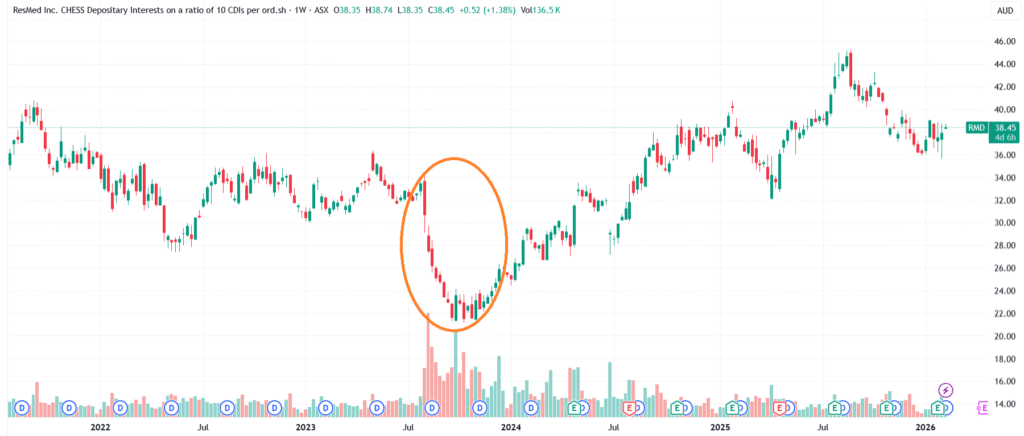
GLP-1 drugs were bringing a real and dramatic benefit. But the impact was overstated.
We see a real disruption with agentic AI. There’s no doubt our lives are changing dramatically. But this is likely to create a bigger tech pie more so than swallowing the existing tech pie by one big new set of products.
Now think about how this same pattern could be playing out with agentic AI and SaaS.
Xero vs ChatGPT for getting audited by the ATO
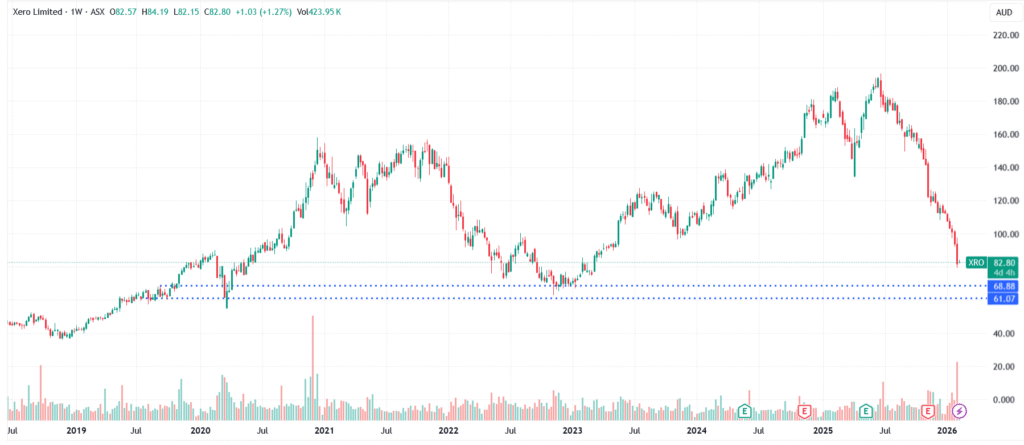
The fear trade in Xero (ASX:XRO) is built on a clean, scary idea. If an agent can do bookkeeping, reconcile accounts, prepare BAS, and generate reports, why pay for accounting software?
Bookkeeping isn’t just math. It’s trust.
Xero is a system of record. It owns the ledger. It owns the permissions. It owns the audit trail. It owns the relationship with accountants, regulators, and banks. That matters more, not less, in an AI-driven world.
Agents are brilliant at producing outputs. They’re terrible at producing reliable outputs.
When the ATO asks how a number was generated, ‘the agent said so’ is not an acceptable answer. Just think about it. Each instance of an agent gives slightly different results. So every agent-submitted BAS is going to be slightly different.
This is why the idea that agents simply replace Xero is lazy thinking. A more realistic outcome is that Xero becomes the operating system and agents become the interface layer.
And Xero is not behaving like a company in decline. Revenue growth remains strong. Cash is flowing. Expansion and investment continues.
The market is not punishing Xero for what it’s doing today. It is punishing it for a hypothetical future where it fails to adapt.
History says companies with data, trust, and distribution usually adapt.
There’s still downside potential in Xero, with the current valuation of ~64X forward PE still demanding solid growth. Obvious technical support sits in the $60-$70 range.
Why agentic AI won’t kill WiseTech Global
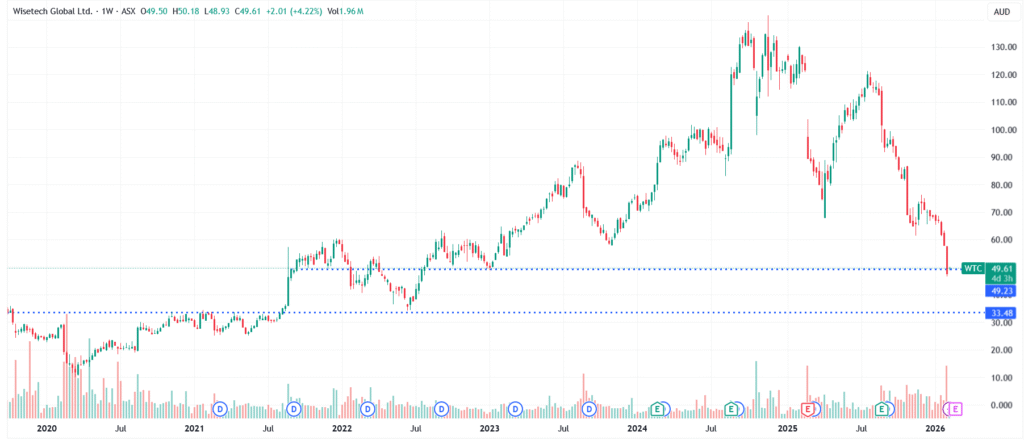
WiseTech Global’s (ASX:WTC) sell-off is driven by a similar misunderstanding, just applied to logistics instead of accounting.
CargoWise is not a productivity toy. It is infrastructure for global trade. Trade that involves customs, tariffs, compliance, exceptions, and a thousand things that go wrong every day.
That complexity scares people. It also protects incumbents.
Agentic AI looks powerful in messy workflows, which makes it feel threatening to WiseTech. In reality, it is far more likely to increase the value of being on the WiseTech platform.
Agents can automate exception handling.
They can reduce training costs.
They can increase throughput per user.
But they still need a backbone. They still need trusted data. They still need a system that actually connects to ports, customs authorities, carriers, and regulators.
WiseTech has spent decades building that spine.
The idea that a greenfield agent simply replaces CargoWise ignores switching costs, integration depth, and the sheer inertia of global trade workflows. Nobody rips out mission-critical logistics software on a whim.
What WiseTech is doing instead is exactly what you would expect. Expanding its platform. Acquiring adjacent capability. Increasing the surface area agents can eventually operate on.
That is not a business being disrupted. That is a business positioning itself to monetise the disruption.
It’s always risky to catch a falling knife and that’s exactly what WTC is right now. If the $50 level gets punched, we’re looking at $33.50 as the next major support. That’s not exactly a rounding error.
WiseTech trades a slightly more reasonable forward PE of ~47X. But that’s still heavy growth implied. So, expect that further falls are very much possible.
The real risk is pricing pressure
This is the actual bear case. Competition, not replacement.
Agents will make ‘good enough’ solutions more accessible. That will pressure the low end of the market. Customers may expect more automation for the same price. Some feature bundles will be devalued.
That is margin pressure, not extinction.
High-quality platforms with deep workflows, regulatory complexity, and embedded distribution can defend pricing by embedding agents themselves. Shallow SaaS tools cannot (yet).
Xero and WiseTech are not shallow.
Why the market is still overshooting
Agentic AI still struggles where it matters most for enterprise software.
Reliability is not there yet. An 80% success rate is impressive in a demo and unacceptable in a regulated workflow.
Governance is hard. Security is messy. Tool-using agents expand attack surfaces. Errors propagate faster, not slower.
Costs are non-trivial. Running agents at scale is expensive. That matters when margins are real and customers are price sensitive.
Most importantly, migration is hard. Replacing a system of record is not a feature decision. It is a business risk decision. Those happen slowly.
The market is pricing fast, clean adoption. Reality will be slower, bumpier, and far more incremental.
The doomsday scenario isn’t impossible. It’s just early.
Agents would need to become reliably safe in regulated environments. They would need to be cheap at scale. And a credible challenger would need to convince customers to migrate systems of record, not just bolt on tools.
If those things happen faster than expected, incumbents will feel it.
Right now, the evidence does not support that timeline.
The Edge
This ASX tech sell-off is about fear, not failure.
Agentic AI will change workflows. It’ll force adaptation. It’ll compress multiples in the short term. It’ll kill weak software businesses.
But it won’t replace Xero or WiseTech overnight. Just like Ozempic did not kill ResMed, it forced the company to adapt and ended up being far more nuanced than the headlines suggested.
The edge here is not denying AI. It is understanding where it lands.
Agents do not kill platforms. They choose platforms.
The question investors should be asking is not ‘does AI matter?’ Of course it does.
It’s ‘which companies become the operating systems agents live inside?’
That is where the real leverage hides.
If you want The Markets IQ take on a SaaS business that’s beaten down with real growth potential, check out this Explosive Growth stock pick.
Until next time, happy investing.
Izaac Ronay
Sign-up to the Explosive Growth portfolio, and follow Izaac Ronay and The Markets IQ on LinkedIn.
Izaac is a broker and trader with Vitti Capital. He brings over 10 years of trading experience with top-tier global trading houses and 20 years of experience analysing and investing in ASX listed equities.
This publication has been prepared by The Markets IQ, a division of Vitti Capital Pty Ltd (ABN 13 670 030 145), which is a Corporate Authorised Representative (001306367) of Point Capital Group Pty Ltd (ABN 41 625 931 900), the holder of Australian Financial Services Licence 518031. This report is for general information only and does not take into account your objectives, financial situation, or needs. It is not personal financial advice or a recommendation to buy, hold, or sell any security. You should consider whether the information is appropriate in light of your circumstances and obtain professional advice before making any investment decision. This report is intended solely for wholesale, sophisticated, or professional investors within the meaning of the Corporations Act 2001 (Cth).
Any views, probabilities, valuations, technical levels, or forecasts expressed are strictly the opinions of the authors as at the date of publication, based on publicly available information and assumptions which may change without notice. They are illustrative only and not predictive of future outcomes. Past performance is not a reliable indicator of future performance.