

The ASX Healthcare Trade Gold Money Just Found
This article is for general information only and is not personal financial advice.
Dear Reader,
We’re seeing a turning point in the markets that you need to pay attention to. It could be the start of the next big swing on the ASX for the back end of 2026.
Staying on top of these kinds of moves can turn an average annual portfolio return into a 20%+ return.
Of course, that requires nailing the call, getting in early and hitting it with full conviction.
FY26 was the golden year.
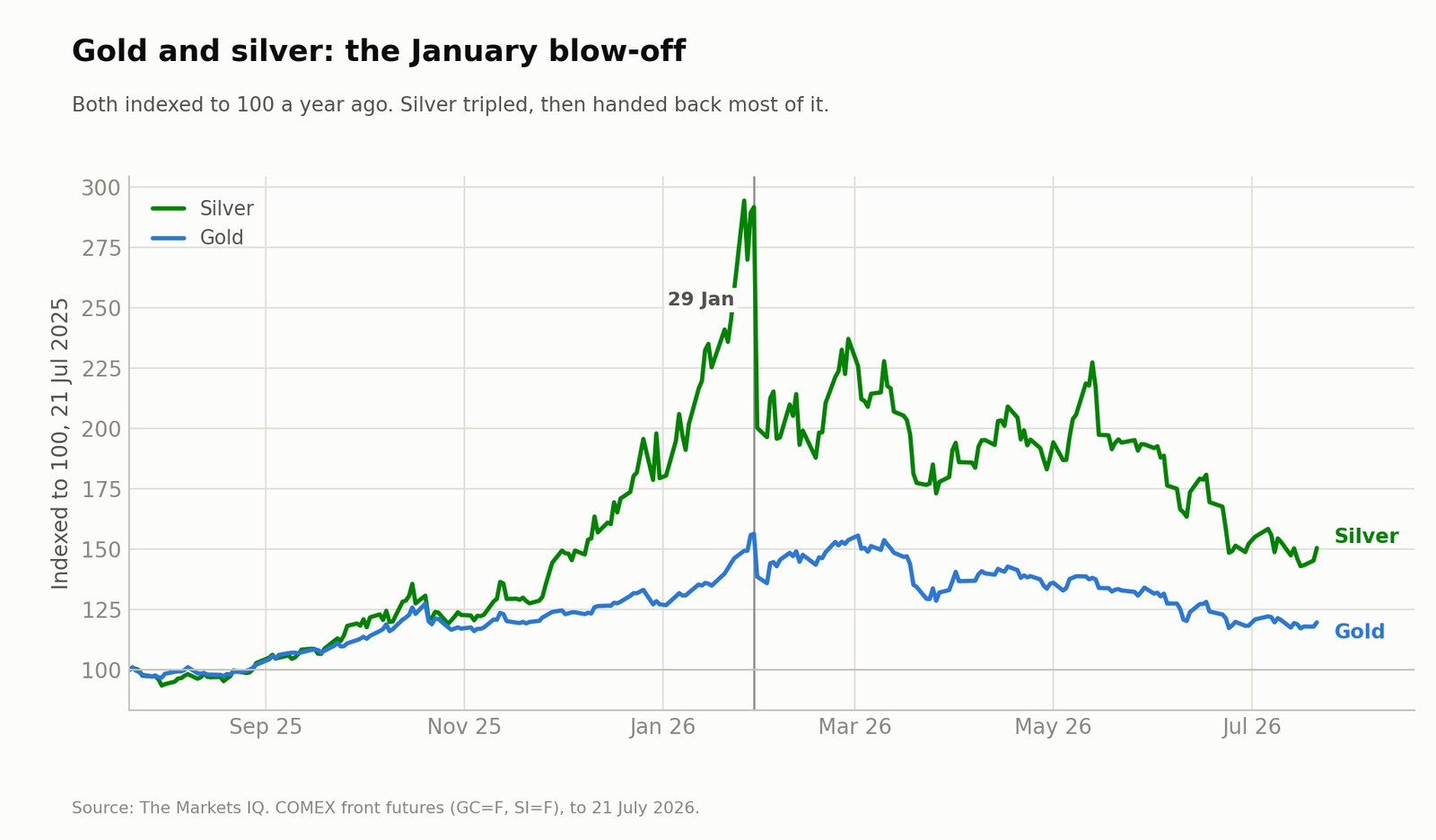
We’re talking about actual gold. Yellow metal was the fad, trading up as much as 70%.
In January it touched US$5,586/oz. Gold miners were the hottest stocks on the ASX.
Something happened, to borrow a Joseph Heller book title. And just like in the book, no one quite knows what happened. More on that shortly.
Today it’s pinned to technical support at US$4,000/oz.
Silver printed a high above US$120, then fell 31% in a session.
This feels a bit like the 1980 version of gold.
In January 1980 the Hunt brothers had run silver to US$50 trying to corner the market. The COMEX cut position limits, then stopped them buying altogether.
By late March silver was US$10.80 and three of the richest men in America needed a US$1.1bn rescue loan. It took until 1988 to finish them off.
Six months on from the top, gold sits at US$4,071 and silver at US$60. That’s 27% and 50% off the highs.
You’d hardly know it from the ASX 200 (ASX:XJO), down about 4% from its own peak. But there’s turmoil beneath the surface.
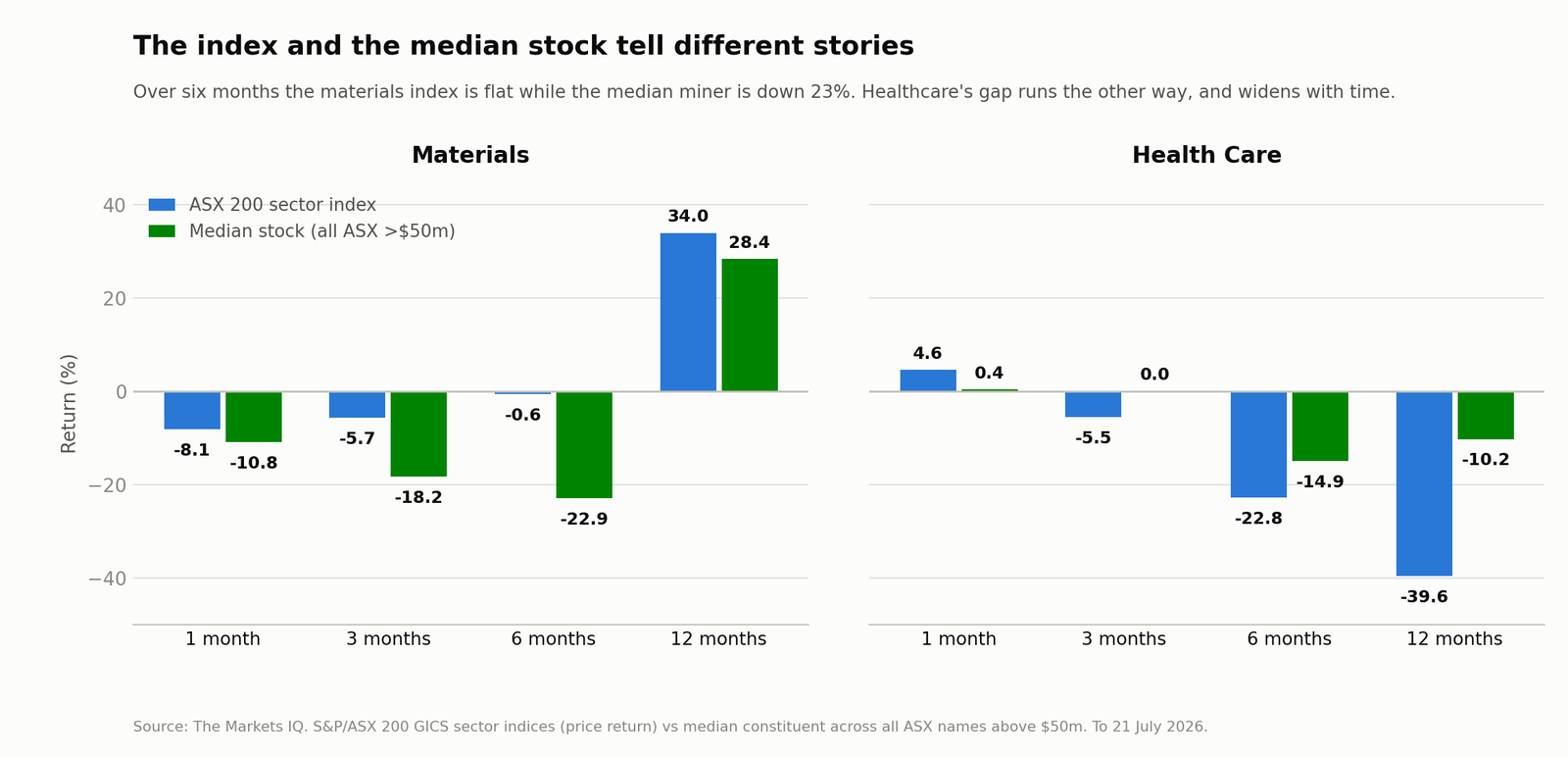
The S&P/ASX 200 Materials index (ASX:XMJ) returned 47.5% in FY26. The best sector on the market by a distance.
It’s also the worst over the last month, down 8.1%.
But that’s just the surface.
Over six months the index has gone nowhere, down 0.6%. Run the numbers across every ASX materials name above $50m and the median stock is down 22.9% over the same stretch.
Under a quarter trade above their 200-day moving average. For miners, cost per ounce decides who survives a move like this. A month ago that figure was half.
83% of them sit more than 20% below their 52-week high, and the median is 39% below. That’s a sector-wide bear market with BHP (ASX:BHP) standing on top of it, close to 40% of the index weight and up 50% on the year.
Four or five giants are carrying a corpse.
Look offshore and you’ll find the same wreckage. Over three months the VanEck Gold Miners ETF (NYSE:GDX) is down 20%, its junior sibling (NYSE:GDXJ) 21%, and the Global X Uranium ETF (NYSE:URA) 25%.
Why The Gold Price Broke
So what ended it?
Was it the war in Iran? Fears of reinflation? Or was gold just overextended?
Kevin Warsh’s nomination as Fed chair was read as hawkish, meaning the market believes he prefers raising interest rates rather than lowering them.
That’s somewhat ironic given how far Trump went in pressuring Powell to lower rates.
Time will tell whether Warsh values a peaceful coexistence with Trump or a stable economy more.
A hawkish stance from the Fed means inflation will likely be assertively contained. That’s a wet blanket for the commodity inflation story.
North American gold funds have since bled US$7.7bn, their weakest start since 2013.
Central banks never stopped buying. The World Gold Council had them adding 244 tonnes in the first quarter. Retail ran for the exit while sovereigns backed up the truck. As we wrote when the metal and the miners came apart, those two separate more often than people expect.
Money that leaves a sector has to go somewhere. Assuming it’s not going into paying down debts, or deleveraging, then it’s going into other assets.
Within the ASX market itself, we saw an interesting pivot, which started in early June. The Materials index turned lower, while Health Care turned up.
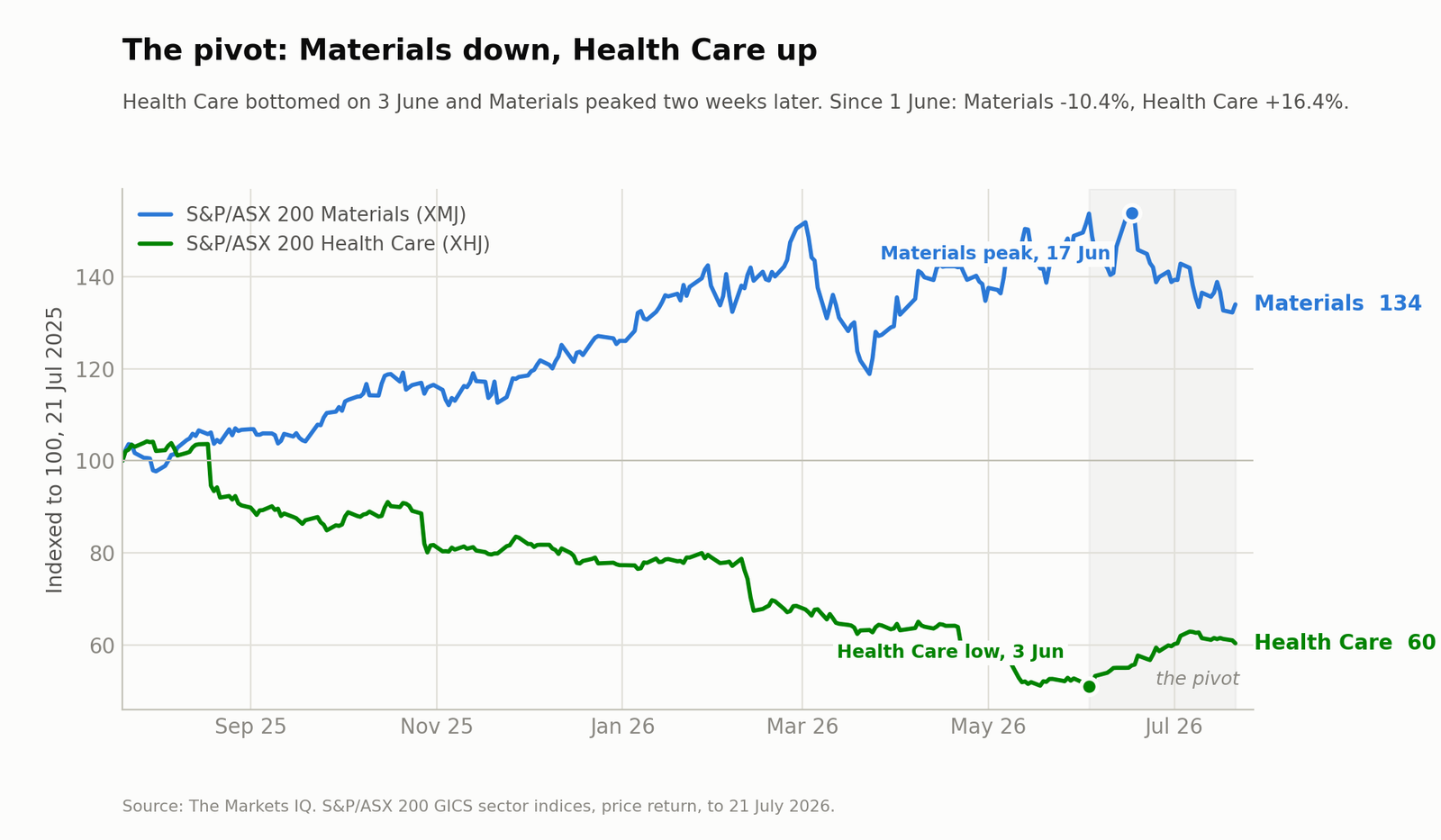
Health Care bottomed on 3 June. Materials peaked two weeks later. Since 1 June, Materials is down 10.4% and Health Care is up 16.4%.
The US Sectors Leading The ASX
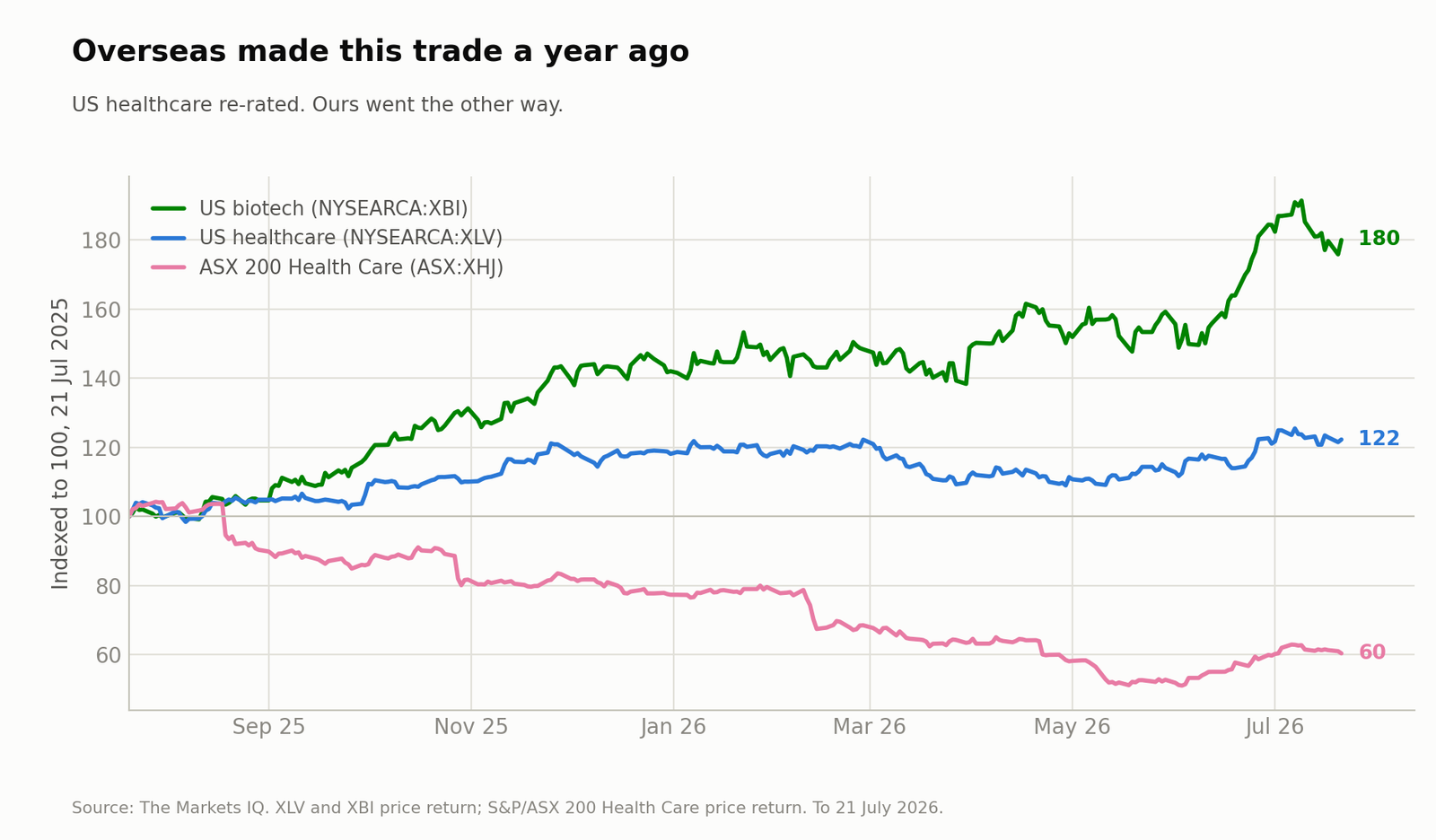
American healthcare has spent a year doing what ASX healthcare hasn’t.
The Health Care Select Sector SPDR (NYSE:XLV), which holds the S&P 500’s healthcare names, is up 24.4% over twelve months. Go down the size scale into small-cap biotech, which sits inside that same sector, and the SPDR S&P Biotech ETF (NYSE:XBI) is up 81%. The healthcare providers (NYSE:IHF) gained 24% in three months alone.
Three things did it.
The Fed cut three times in late 2025 to 3.50-3.75%. Early stage biotech is among the longest-duration assets to profitability you can own. An approval can sit a decade away and every move in the discount rate reprices the whole pipeline.
The buyers arrived to the tune of US$106bn.
That’s global biopharma M&A to early June across 201 deals, with average deal size up from US$365m to US$527m.
Vertex (NASDAQ:VRTX) paid a 102% premium for Crinetics (NASDAQ:CRNX). Big pharma is staring at a US$180bn patent cliff by 2028 and has decided to buy its way out.
Also, Trump’s campaign to bring down US pharmaceutical pricing saw some compromise.
After the Most Favored Nation pricing order, manufacturers traded Medicaid pricing and US manufacturing commitments for tariff relief. Pfizer, AstraZeneca, EMD Serono, Lilly and Novo Nordisk all signed. The worst case came off the table.
Now look at what we did with the same twelve months.
ASX Healthcare Is a CSL-Shaped Hole
The S&P/ASX 200 Health Care index (ASX:XHJ) is down 39.6% over twelve months. Only tech has done worse.
Across the wider market, the median healthcare stock is down 10%.
The index fell four times as far as the typical stock in it. That’s three companies at the top wobbling in unison.
CSL (ASX:CSL) is down 51% in a year. Interim CEO Gordon Naylor’s 90-day review on 11 May cut FY26 guidance to about US$15.2bn revenue and US$3.1bn NPATA, flagged roughly US$5bn of further impairments on the Vifor intangibles, and took the shares down 20.6% in a session.
The biggest one-day fall in the company’s history.
Cochlear (ASX:COH) cut FY26 profit guidance from $435-460m to $290-330m on 22 April and closed down 39.4%. Over $4bn of market value gone between morning tea and lunch.
ResMed (ASX:RMD) is off 29%, caught between the re-entry of Philips (NYSE:PHG) to sleep apnoea and fears that GLP-1 weight-loss drugs shrink the market.
Three casualties weighed heavily on the sector index, while the average player was dragged lower in sympathy.
Then, in early June, we saw things stabilise.
Since 1 June the ASX 200 healthcare index is up 16.4%, while the market has gone sideways. Materials is down 10.4% over the same stretch.
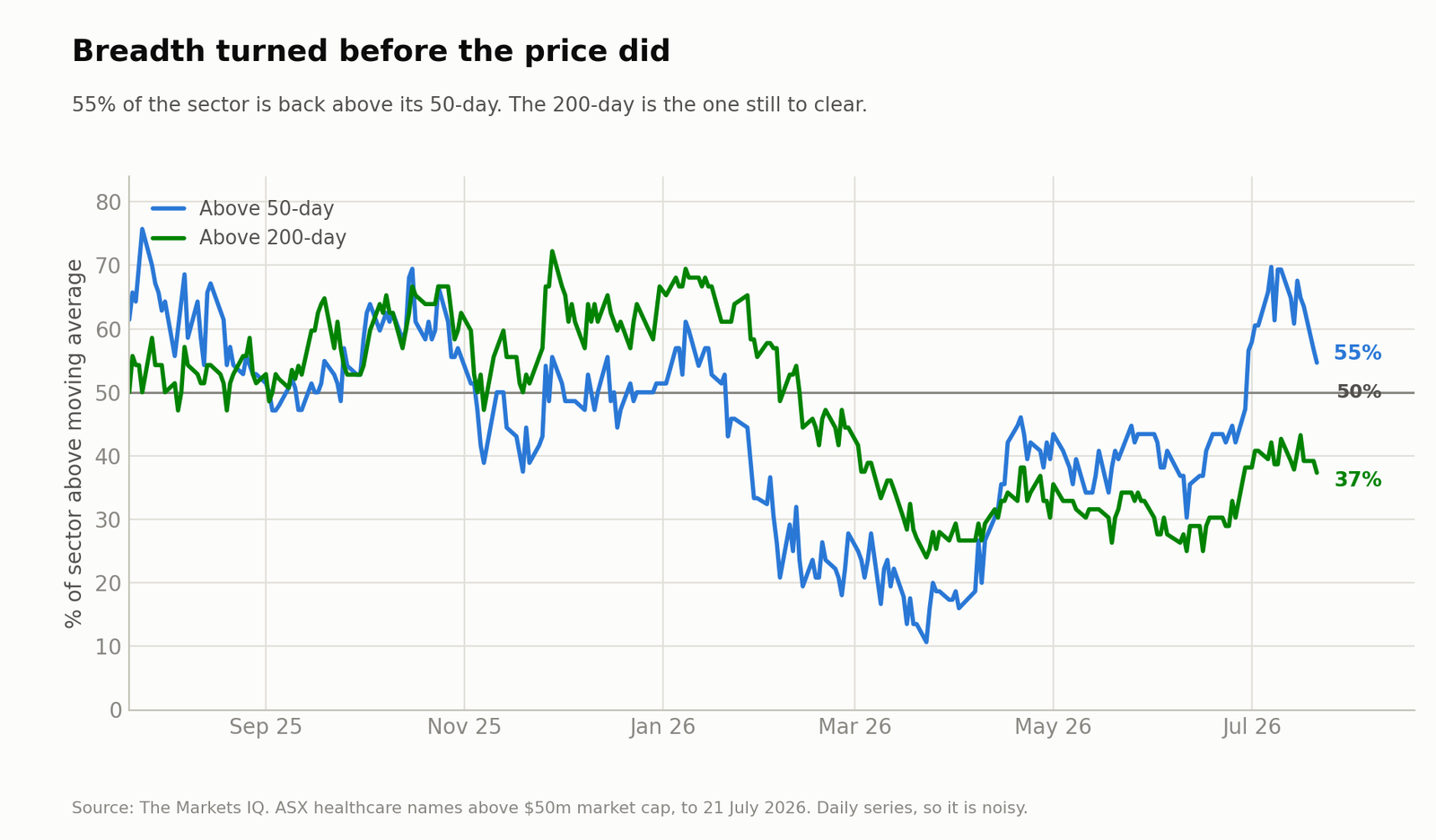
Breadth moved first, which is the order you want. Healthcare names above their 50-day moving average went from 43% to 55% in a month. Above the 200-day, 30% to 37%.
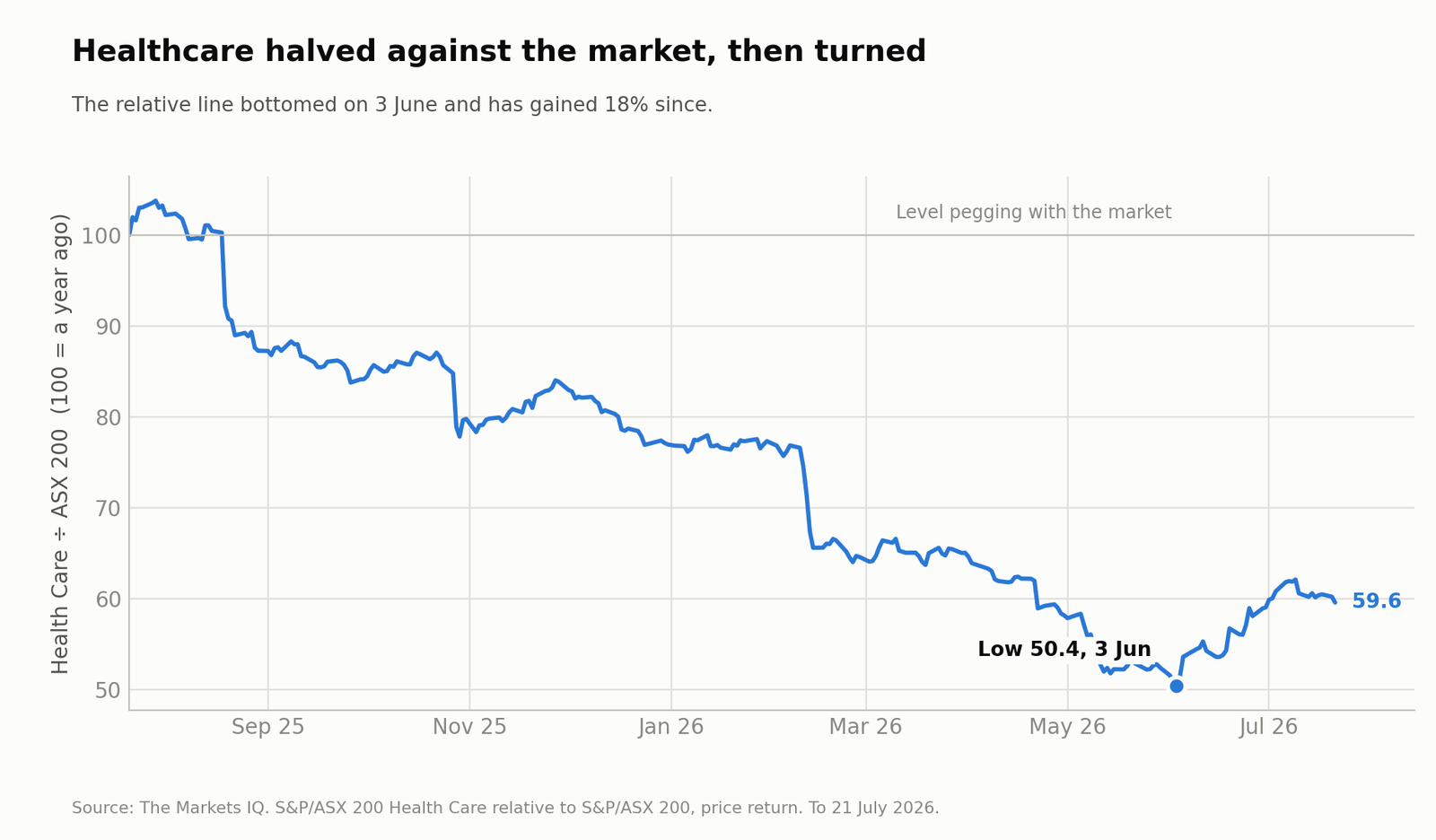
Then the relative line turned. Track the ASX 200 Health Care index against the ASX 200 itself, both set to 100 a year ago, and healthcare halved. It bottomed at 50.4 on 3 June. It’s 59.6 today, an 18% gain against the market in seven weeks.
Three quarters of the sector still sits more than 20% below its highs. There’s a great deal left to repair, which is the point.
Three ASX Healthcare Stocks For Your Watchlist
You might have spotted the tension. If the median healthcare stock only fell 10%, the sector was never cheap. Three giants were.
So there are two trades here, and you’d hold them for different reasons.
CSL (ASX:CSL) trades on 12.9x forward earnings against a decade spent mostly between 25x and 35x. It yields 3.5% and has come off the lows. The catalyst is FY26 results, 18 August. The risks are still there. No permanent CEO, US$5bn of impairments still to land, and a Seqirus demerger nobody can put a date on.
ResMed (ASX:RMD) is the quality name the market mispriced. March-quarter revenue was US$1.43bn, up 11%, or 8% in constant currency, with non-GAAP EPS of US$2.86. Both beat. The stock fell anyway on GLP-1 fears and Philips coming back into the fray. It’s on 16.2x forward.
We’re yet to see what happens with the Philips re-entry. But we know at the moment that ResMed is the market leader in a sector that’s heavily under-diagnosed and under-treated. There’s arguably plenty of room for both companies to see rapid growth for another decade before they need to have a serious, price-based showdown.
Sonic Healthcare (ASX:SHL) has revenue growth of 16.6%, a 5.1% yield, sits on 15.8x forward, and has climbed back above its 200-day.
These are all profitable businesses. But there are plenty of up and coming plays worth watching too.
Aroa Biosurgery (ASX:ARX) has just made the turn. Revenue of NZ$86.6m in the year to March, up from NZ$63.4m two years earlier, on an 86% gross margin. EBITDA went from minus NZ$4.4m to plus NZ$9.9m across those two years, and FY26 delivered the company’s first net profit at NZ$3.9m. Free cash flow turned positive too. A $198m company that has stopped burning money.
Telix (ASX:TLX) is bigger and messier. Revenue grew 56% to US$804m last year. But EBITDA went backwards, from US$62m to US$35m, and the company posted a US$7.1m loss after two straight profitable years. It carries US$467m of debt against US$142m of cash. The growth is real. Profitability is something it keeps choosing to defer.
ASX Sector Rotation Story Risks
Three things.
Healthcare breadth above the 200-day is 37%. It needs to clear 50%. Until it does, you’re looking at a bounce off a washed-out base rather than a confirmed re-rating.
The heavyweights still have to prove it. The tell I’m watching is a big name posting a mediocre result and going up anyway. When bad news stops being punished, it’s a sign that love is back for healthcare. CSL on 18 August is one such live test.
The exchange rate plays an important part. Most healthcare stocks earn the big bucks in USD, offshore. A stronger Australian dollar is a risk. That means interest rate hikes in Australia or further rate cuts in the US are a risk.
The Edge
The resources trade ran for two years and made a lot of people a lot of money. It’s tired. The breadth is gone, the easy money has been made, and now investors need to see a reason to chase it further.
ASX healthcare has been suffering. While most of the damage was done by three names, the rest of the sector has also been underwhelming. There has been lots of innovation and growth with no value attached to it.
Check out the Explosive Growth portfolio for more interesting healthcare stocks.
Until next time, happy investing.
Izaac Ronay
Izaac Ronay is the Editor of The Markets IQ. He brings over 10 years of trading experience with top-tier global trading houses and 20 years of experience analysing and investing in ASX listed equities.
This publication has been prepared by The Markets IQ, a division of Vitti Capital Pty Ltd (ABN 13 670 030 145), which is a Corporate Authorised Representative (001306367) of Point Capital Group Pty Ltd (ABN 41 625 931 900), the holder of Australian Financial Services Licence 518031. This report is for general information only and does not take into account your objectives, financial situation, or needs. It is not personal financial advice or a recommendation to buy, hold, or sell any security. You should consider whether the information is appropriate in light of your circumstances and obtain professional advice before making any investment decision. This report is intended solely for wholesale, sophisticated, or professional investors within the meaning of the Corporations Act 2001 (Cth).
Any views, probabilities, valuations, technical levels, or forecasts expressed are strictly the opinions of the authors as at the date of publication, based on publicly available information and assumptions which may change without notice. They are illustrative only and not predictive of future outcomes. Past performance is not a reliable indicator of future performance.